


How does Amazon’s on-demand book printing work?
Print-on-demand has changed how books get made. Amazon's KDP lets authors publish without buying thousands of copies first. But is it worth it?
Amazon's print-on-demand works through their Kindle Direct Publishing (KDP) platform. Authors upload manuscript files and cover designs, choose printing options, set prices, and Amazon prints books only when customers order them, eliminating inventory costs while providing worldwide distribution.
I've helped many authors navigate the print-on-demand world. The freedom to publish without gatekeepers is revolutionary, but there are important details you need to know before diving in.
How does Amazon book print-on-demand work?
I remember my first time using Amazon's print-on-demand service. The process seemed complicated, but it's actually straightforward once you understand it.
Amazon's KDP print-on-demand process starts with authors creating an account, uploading properly formatted manuscript and cover files, selecting print options (trim size, paper type, color/B&W), setting pricing, and publishing. When a customer orders, Amazon prints and ships the book, depositing royalties to the author's account.

The Step-by-Step KDP Process
Let me walk you through exactly how Amazon's print-on-demand system works. I've guided dozens of authors through this process, and these are the key steps:
-
Account Setup: First, you'll need to create a KDP account. This gives you access to the dashboard where you'll manage your entire self-publishing journey. Amazon requires basic tax information since they'll be paying you royalties.
2 -
Book Preparation: Before uploading, you need to format your manuscript according to KDP guidelines. This includes setting proper margins, page sizes, and ensuring your images meet quality standards. For covers, you'll need to create a full wrap-around design that includes front, spine, and back.
-
Uploading Content: Once your files are ready, you'll upload both your manuscript (typically as a PDF) and your cover design through the KDP dashboard. Amazon's system will check for formatting issues and alert you to any problems.
-
Selecting Print Options: This is where you make important decisions about your book's physical characteristics: Option Choices Impact Trim Size Various sizes (5"×8", 6"×9", etc.) Affects reader experience and printing cost Paper Type White or cream Affects readability and feel Cover Finish Glossy or matte Affects appearance and durability Interior Black & white or color Significantly affects printing cost 3 -
Pricing and Distribution: Amazon calculates your minimum list price based on printing costs. You'll earn 60% royalties on paperbacks minus printing costs. You can choose expanded distribution to reach bookstores and libraries.
1 -
Publishing: After reviewing a digital proof (or ordering a physical proof), you can publish your book, making it available on Amazon's marketplace.
-
On-Demand Production: When a customer orders your book, Amazon's system automatically sends the order to the nearest printing facility, where your book is printed, bound, and shipped directly to the customer—all without you handling inventory.
How much does Amazon charge to print a book?
When I first looked into print-on-demand, the pricing structure confused me. Let me break it down in simple terms.
Amazon KDP charges printing costs based on a formula: Fixed cost + (page count × per-page cost). For a 300-page black-and-white 6"×9" paperback sold in the US, printing costs approximately $4.45. Authors must price books above the minimum threshold (printing cost ÷ royalty rate) to ensure profitability.
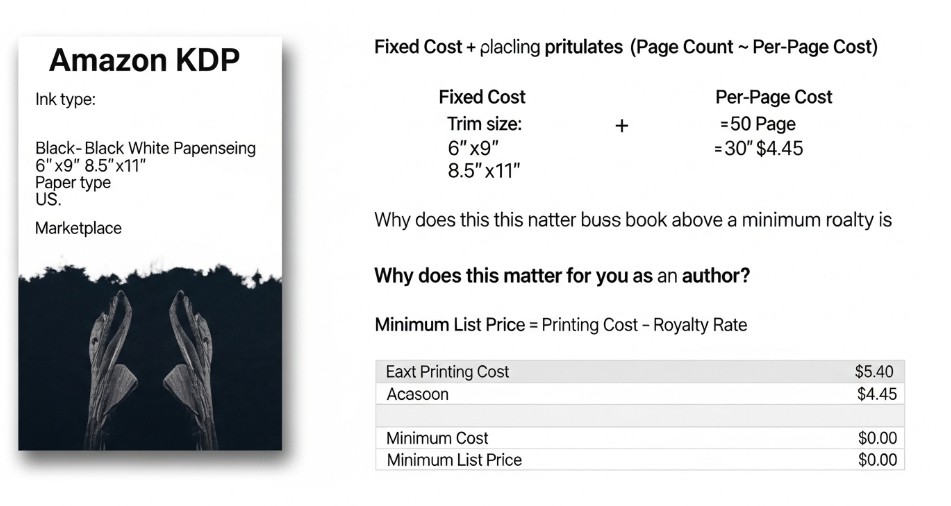
Understanding Amazon's Printing Cost Structure
Amazon's printing costs can seem complicated at first, but they follow a consistent formula. I've published multiple books through KDP, and here's what I've learned about their pricing structure:
-
Base Formula: Amazon calculates printing costs using: Fixed cost + (page count × per-page cost) = printing cost
4 -
Fixed Costs: These vary by marketplace and book size but typically range from $0.85 to $1.20 for standard paperbacks in the US market.
-
Per-Page Costs: These vary based on whether you choose black-and-white or color printing: Interior Type Approximate Per-Page Cost (US) Black & White $0.012 per page Standard Color $0.07 per page Premium Color $0.12 per page 4 -
Minimum List Price: Amazon enforces a minimum list price calculated as: Printing cost ÷ (royalty rate ÷ 100). With the standard 60% royalty rate for paperbacks, this means: Printing cost ÷ 0.6 = minimum list price
4 -
Real-World Example: For my last 250-page black-and-white paperback (6"×9"):
- Fixed cost: $0.85
- Per-page cost: 250 pages × $0.012 = $3.00
- Total printing cost: $0.85 + $3.00 = $3.85
- Minimum list price: $3.85 ÷ 0.6 = $6.42 (rounded up to $6.99)
- My actual list price: $14.99
- My royalty per book: ($14.99 × 0.6) - $3.85 = $5.14
The key insight I've gained is that longer books and color interiors dramatically increase printing costs, which directly impacts your minimum price and potential profits.
How does print-on-demand work with Amazon?
I've tried several print-on-demand services, and Amazon's system stands out for its integration with the world's largest bookstore.
Print-on-demand with Amazon works through their integrated KDP platform. Authors upload book files once, and Amazon handles printing, shipping, and customer service automatically. When a customer orders, the nearest Amazon printing facility produces the book, ships it with Prime delivery options, and handles returns, while authors receive royalties without managing inventory.
The Amazon POD Ecosystem
Amazon's print-on-demand system is remarkable for its seamless integration with their massive retail platform. Having published through their system for years, I can explain how the entire ecosystem works together:
-
Single Platform Integration: Once your book is in the KDP system, it's automatically listed on Amazon's marketplace—the world's largest bookstore. This gives you instant access to millions of potential readers without additional work.
5 -
Global Printing Network: Amazon maintains printing facilities worldwide. When a customer orders your book, it's routed to the facility closest to them, reducing shipping times and costs. This global network means your book is effectively "in stock" everywhere, without you shipping a single copy internationally.
-
Amazon Prime Compatibility: Your print-on-demand books are eligible for Amazon Prime shipping, making them more attractive to the millions of Prime subscribers who expect fast delivery.
-
Inventory Management: The most liberating aspect of Amazon's POD system is never dealing with inventory. Before POD, self-published authors often had garages full of books. With KDP, Amazon handles everything—printing, storage, shipping, and even returns.
-
Dynamic Catalog: You can update your book content, cover, or pricing at any time. When you submit changes, Amazon simply updates the files in their system, and all future orders will use the new version.
-
Sales Reporting: The KDP dashboard provides detailed sales reports, showing exactly when and where your books are selling, helping you track performance and adjust marketing strategies.
-
Expanded Distribution: Beyond Amazon's own marketplace, you can opt into expanded distribution, which makes your book available to bookstores, libraries, and academic institutions through wholesalers—though at a lower royalty rate.
The real magic of Amazon's system is how it removes traditional publishing barriers. I remember when authors needed publishers, distributors, and retailers to reach readers. Now, KDP combines all these functions in one platform, letting authors focus on writing rather than logistics.
What are the disadvantages of Amazon book printing?
Despite using Amazon KDP for years, I've encountered several frustrating limitations that potential authors should know about.
The main disadvantages of Amazon's print-on-demand service include inconsistent print quality between facilities, limited paper and binding options compared to traditional publishers, lower profit margins due to printing costs, no bulk order discounts for authors, and exclusive distribution requirements if enrolled in KDP Select.
Real Limitations of Amazon's POD Service
While Amazon's print-on-demand service offers tremendous advantages, my experience has revealed several significant drawbacks that authors should consider before committing:
-
Inconsistent Print Quality: This is perhaps the most frustrating aspect of KDP. Books printed at different facilities can vary noticeably in quality. I've ordered copies of my own books that arrived with different paper weights, slightly misaligned covers, or inconsistent color reproduction.
6 -
Limited Production Options: Compared to traditional printing services or even some competing POD providers, Amazon offers fewer options for: Feature KDP Limitations Binding Types No hardcover with dust jacket, no spiral binding, no leather options Paper Types Limited to standard white or cream, no premium or specialty papers Special Features No foil stamping, embossing, or die-cutting Trim Sizes Limited selection compared to offset printing 3 -
Higher Per-Unit Costs: POD books cost more to produce per unit than traditional offset printing, which means either lower profits for authors or higher prices for readers. This makes it difficult to compete on price with traditionally published books.
-
No Author Bulk Discounts: Unlike some POD services, Amazon doesn't offer significant discounts when authors purchase their own books in bulk for events or direct sales.
-
Limited Interior Design Options: KDP's system works best with straightforward layouts. Books with complex formatting, unusual image placements, or specialized design elements often don't translate well to their system.
-
Exclusivity Requirements for KDP Select: If you enroll your ebook in KDP Select for additional benefits, you must make it exclusive to Amazon, limiting your distribution options.
8 -
Print Quality Issues for Graphics-Heavy Books: Authors of children's books, photography books, or art books often report disappointment with color reproduction and image quality.
7
For professional book production, especially for premium products, many publishers turn to specialized equipment like those offered by Kylin Machine. Their post-press machines for book production provide higher quality and more options than standard print-on-demand services. For authors looking to produce premium books with special finishes, exploring professional binding and finishing equipment might be worthwhile.
Conclusion
Amazon's print-on-demand service revolutionizes publishing by eliminating inventory costs and providing global distribution. Despite quality inconsistencies and limited options, it remains the most accessible path for self-published authors to reach readers worldwide.

发表回复