

What is the difference between a box and a carton
What is the difference between a box and a carton?
Confused by packaging terms? Using "carton" when you mean "box" can cause costly errors in production. I'll clear up the difference so you can communicate precisely with your partners.
A box is a general term for any container, while a carton is a specific type of box made from paperboard or corrugated fiberboard. All cartons are boxes, but not all boxes are cartons. Cartons are primarily used for packaging goods, often for shipping or retail.
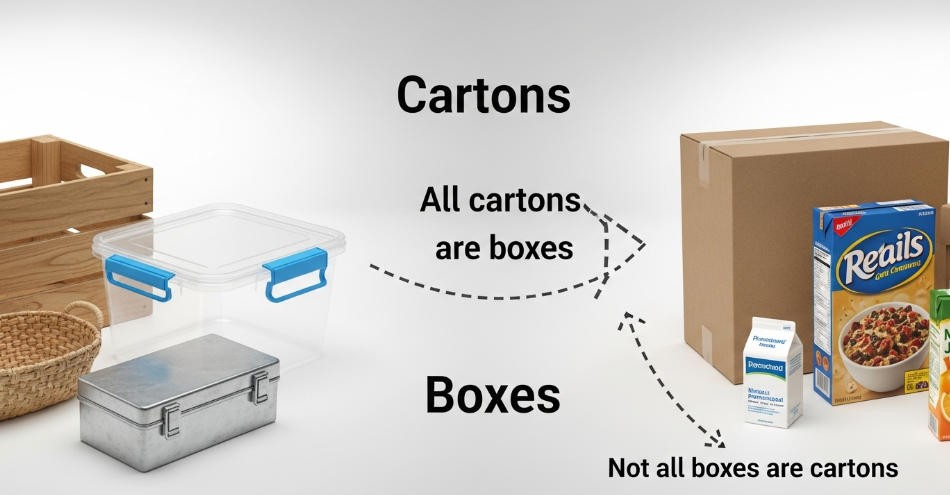
It seems simple, but understanding this distinction is crucial in the packaging industry. These details affect everything from material costs to the type of machinery you need for your production line. Let's dive deeper to see why getting these terms right matters for your business.
So, is a carton just another name for a box?
You hear these terms used almost interchangeably every single day. This casual mix-up can lead to serious communication breakdowns with suppliers and clients, costing you time and money. Let’s define them clearly to avoid any confusion.
No, they are not just different names for the same thing. A "box" is a broad term for a container and can be made of wood, plastic, metal, or paper. A "carton" is specifically a box made from paper-based materials like folding paperboard or corrugated fiberboard.

In my years of manufacturing packaging machinery at Kylin Machine, I’ve seen this confusion cause real problems. A client might request a machine for "boxes" when they really mean "folding cartons." The machinery required is completely different. To make it simple, think about the material and the purpose. A wooden crate is a box, but it's not a carton. A cereal box is a carton, and it's also a box. This distinction is the first step in specifying a project correctly.
Here’s a simple breakdown to help you remember:
| Feature | Box | Carton |
|---|---|---|
| Definition | A general term for a container | A specific type of box made from paper |
| Material | Can be wood, plastic, metal, paper, etc. | Paperboard or corrugated fiberboard |
| Common Use | Storage, shipping, general containment | Product packaging, shipping goods |
| Example | A toolbox, a wooden crate, a jewelry box | A milk carton, a shipping carton, a cereal box |
)
It seems simple, but understanding this distinction is crucial in the packaging industry. These details affect everything from material costs to the type of machinery you need for your production line. Let's dive deeper to see why getting these terms right matters for your business.
So, is a carton just another name for a box?
You hear these terms used almost interchangeably every single day. This casual mix-up can lead to serious communication breakdowns with suppliers and clients, costing you time and money. Let’s define them clearly to avoid any confusion.
No, they are not just different names for the same thing. A "box" is a broad term for a container and can be made of wood, plastic, metal, or paper. A "carton" is specifically a box made from paper-based materials like folding paperboard or corrugated fiberboard.

In my years of manufacturing packaging machinery at Kylin Machine, I’ve seen this confusion cause real problems. A client might request a machine for "boxes" when they really mean "folding cartons." The machinery required is completely different. To make it simple, think about the material and the purpose. A wooden crate is a box, but it's not a carton. A cereal box is a carton, and it's also a box. This distinction is the first step in specifying a project correctly.
Here’s a simple breakdown to help you remember:
| Feature | Box | Carton |
|---|---|---|
| Definition | A general term for a container | A specific type of box made from paper |
| Material | Can be wood, plastic, metal, paper, etc. | Paperboard or corrugated fiberboard |
| Common Use | Storage, shipping, general containment | Product packaging, shipping goods |
| Example | A toolbox, a wooden crate, a jewelry box | A milk carton, a shipping carton, a cereal box |
)
It seems simple, but understanding this distinction is crucial in the packaging industry. These details affect everything from material costs to the type of machinery you need for your production line. Let's dive deeper to see why getting these terms right matters for your business.
So, is a carton just another name for a box?
You hear these terms used almost interchangeably every single day. This casual mix-up can lead to serious communication breakdowns with suppliers and clients, costing you time and money. Let’s define them clearly to avoid any confusion.
No, they are not just different names for the same thing. A "box" is a broad term for a container and can be made of wood, plastic, metal, or paper. A "carton" is specifically a box made from paper-based materials like folding paperboard or corrugated fiberboard.
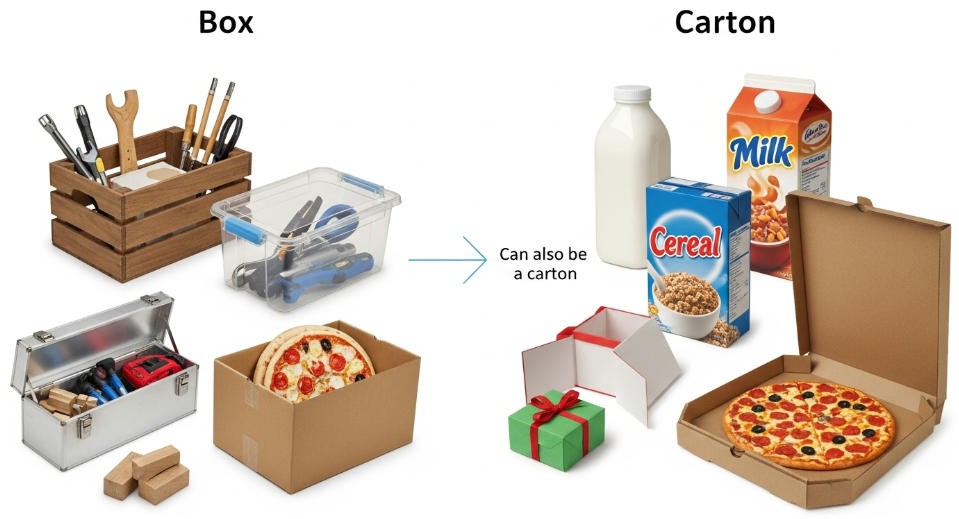
In my years of manufacturing packaging machinery at Kylin Machine, I’ve seen this confusion cause real problems. A client might request a machine for "boxes" when they really mean "folding cartons." The machinery required is completely different. To make it simple, think about the material and the purpose. A wooden crate is a box, but it's not a carton. A cereal box is a carton, and it's also a box. This distinction is the first step in specifying a project correctly.
Here’s a simple breakdown to help you remember:
| Feature | Box | Carton |
|---|---|---|
| Definition | A general term for a container | A specific type of box made from paper |
| Material | Can be wood, plastic, metal, paper, etc. | Paperboard or corrugated fiberboard |
| Common Use | Storage, shipping, general containment | Product packaging, shipping goods |
| Example | A toolbox, a wooden crate, a jewelry box | A milk carton, a shipping carton, a cereal box |
Understanding this helps you order the right materials and choose the right equipment for the job.
How many boxes are in a carton?
Planning your shipping and logistics can be a real headache. Getting the item count wrong per shipping unit can throw off your entire inventory, increase costs, and create fulfillment delays. Let’s look at how cartons help organize this.
There is no standard answer. The number of individual product boxes that fit into an outer carton depends entirely on the size of the product boxes and the dimensions of the shipping carton. This count, known as the case pack, is set by the manufacturer for logistics.

This question introduces us to the levels of packaging. In our industry, we think in three stages.
The Three Levels of Packaging
- Primary Packaging: This is the container that directly holds the product. Think of the beautiful rigid box your new smartphone comes in or the folding carton for a bottle of cologne. Its main job is to protect and present the product to the consumer.
- Secondary Packaging: This is the "carton" in the question. It's often called a master carton or a case. It groups a number of primary packages together for easier handling and distribution. For example, a corrugated carton might hold 12 smartphone boxes. Its main job is logistics.
- Tertiary Packaging: This is used for bulk handling and shipping. A great example is a stretch-wrapped pallet that holds dozens of secondary cartons. Its job is to make it easy to move large quantities of product with a forklift.
I remember a client who miscalculated their master carton size. Their automated palletizing machine couldn't handle the new dimensions, causing a huge production delay. It shows how a small detail like case pack size has big consequences down the line.
What is the difference between a pack and a carton?
You see the words "pack" and "carton" on products all the time. Are they the same thing? Using the wrong term when planning your packaging can be confusing for everyone involved. Let’s clarify this common point of confusion.
A "pack" typically refers to multiple items bundled together for a single sale, often with shrink-wrap or a simple paperboard sleeve. A "carton" is a fully enclosed box that contains these items, protecting them for shipping and handling.
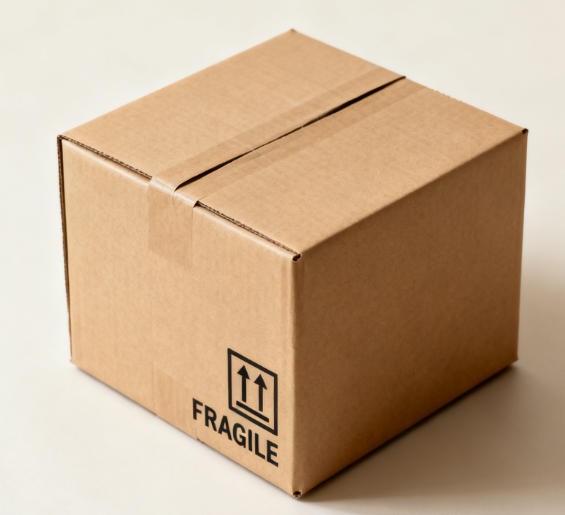
The key difference is function. A pack is designed for retail convenience, while a carton is designed for protection and logistics. A 6-pack of soda cans is held together by plastic rings or a paperboard wrap—that's the "pack." Those 6-packs are then placed into a larger corrugated "carton" for shipping to the grocery store. The machinery to create a shrink-wrapped pack is very different from the machinery we build at Kylin Machine to create a sturdy carton or a premium rigid box.
Here’s a quick comparison:
| Feature | Pack | Carton |
|---|---|---|
| Primary Goal | Group items for retail sale (unitizing) | Protect items during transit (logistics) |
| Structure | Often minimal, like a sleeve or film | A complete, six-sided container |
| Material | Thin paperboard, plastic wrap, plastic rings | Folding carton paperboard, corrugated fiberboard |
| Example | A 4-pack of yogurt cups | The shipping case that holds 8 of those 4-packs |
A customer might sell a "twin pack" of their product, but they ship it to distributors in a "carton" of 12 twin packs. Knowing the difference helps you plan both your retail strategy and your shipping operations.
What are the three main types of paper-based boxes?
You know you need a box for your product, but where do you start? The options can seem overwhelming, and choosing the wrong one can hurt your brand image or fail to protect your product. Let me simplify it by breaking down the main types we work with.
In the paper packaging world, the three main types of boxes are folding cartons, rigid boxes, and corrugated boxes. Each is made differently and serves a distinct purpose, from simple retail packaging to premium gift boxes and heavy-duty shipping.

As a manufacturer of box-making machinery, this is my specialty. The construction of the box determines the machine you need. Let's look at each one.
1. Folding Cartons
These are the most common type of product box. They are made from paperboard that is printed, cut, and scored. We ship them flat to our customers, who then assemble them on their production line. They are cost-effective and great for lightweight products.
- Example: Cereal boxes, medicine boxes, cosmetic packaging.
2. Rigid Boxes
Also known as set-up boxes, these are my favorite. They are made from thick, condensed paperboard that is not collapsible. This gives them a sturdy, high-end feel. They provide excellent protection and a premium unboxing experience. At Kylin Machine, we build advanced equipment like Robotic Spotters specifically for making these luxury boxes.
- Example: iPhone boxes, luxury watch boxes, board games.
3. Corrugated Boxes
These are the workhorses of the

发表回复