

How to Bind a 500-Page Book at Home Again Without It Falling Apart?
I know the feeling. A big book breaks, the pages slide, and the spine turns into dust. If I rush the repair, it fails again and wastes my time.
Yes, I can bind a 500-page book at home, but I need to split the block, rebuild the spine with flexible glue and cloth, then press it hard before I add or reuse the cover.
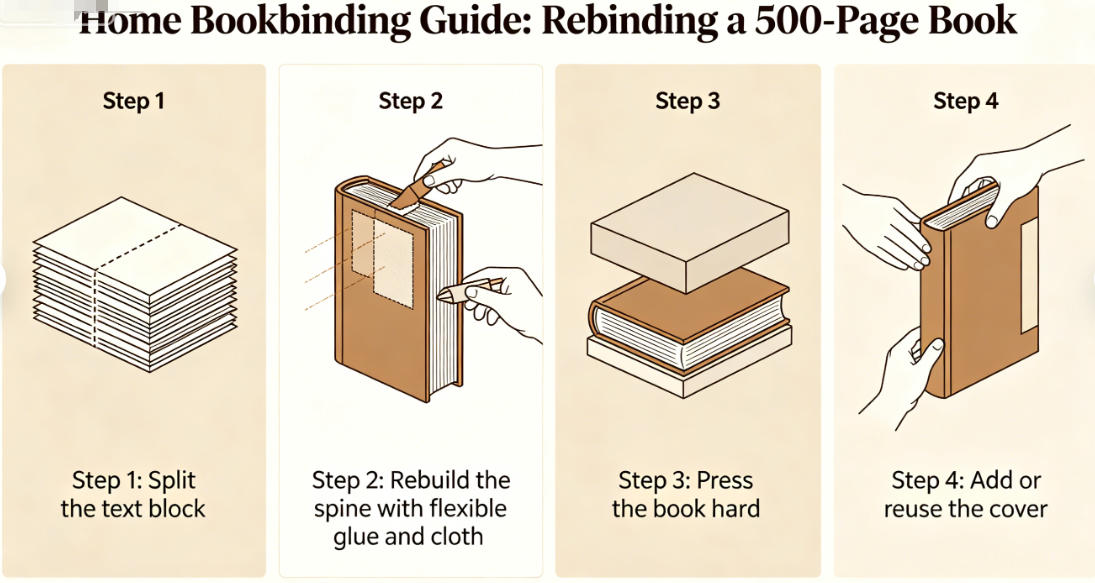
I learned one thing the hard way. A 500-page book does not fail because I lack “strength.” It fails because the spine has stress, the glue is wrong, or the book is too thick for one solid block. If I treat it like three smaller books that live in one cover, the result stays straight, opens well, and lasts longer.
How do I bind a large book at home without cracked spines?
I can clamp a thick book and pour glue on it, but the first open will crack it. I can also sew it wrong and watch the signatures rip out later.
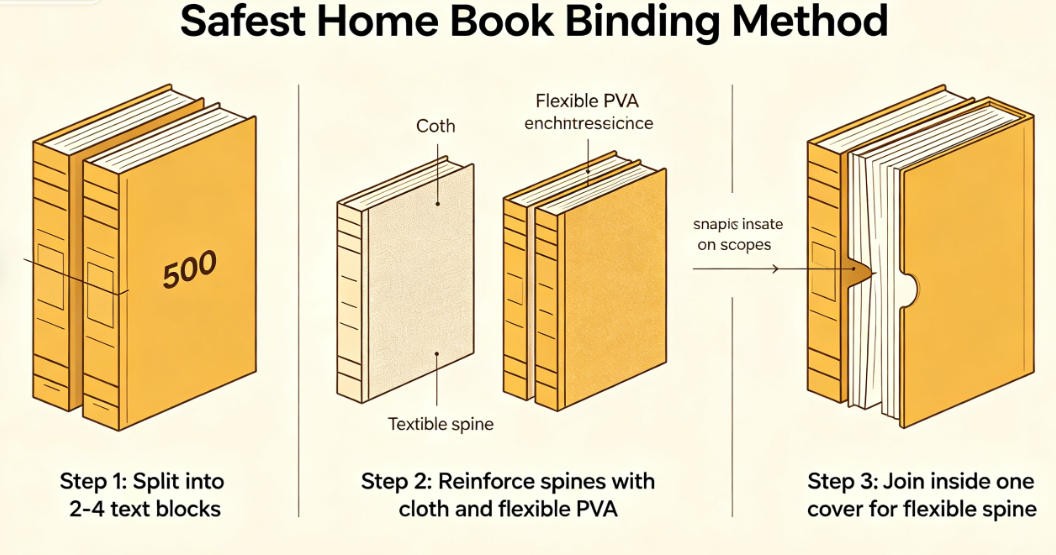
The safest home method is to split the 500 pages into 2–4 smaller text blocks, reinforce each spine with cloth and flexible PVA, then join them inside one cover so the spine bends instead of snapping.
Step 1: I decide what I am repairing
When I say “bind,” I mean two different jobs. I either repair a paperback-style glue spine, or I rebuild a hardback-style case and attach the book block. I always start by checking the old structure.
| What I see | What it means | What I do |
|---|---|---|
| Pages are loose in chunks | Old glue failed | I remove old glue, rebuild spine, re-glue |
| Pages are loose one by one | Paper tore at the spine | I reattach with a “hinge” strip or re-sew if needed |
| Cover is fine but block is loose | Case joint failed | I re-case or reattach endpapers |
| Spine is rounded and stiff | Too much brittle glue | I clean deeper and use flexible glue + cloth |
Step 2: I split the book block so it can bend
A 500-page block is heavy. If I glue it as one piece, the spine becomes thick and stiff. Then the first wide open pulls the first pages loose. I split it into 2 to 4 blocks, like 125–250 pages each, depending on paper weight.
I stack the pages in order, then I create clean “sections” using binder clips and scrap boards. I label each block with a sticky note so I do not mix them. I also trim stray glue and old paper with a sharp blade, but I keep it light. If I cut too deep, I lose margin.
Step 3: I rebuild the spine with simple materials
I use flexible PVA bookbinding glue if I can get it. I avoid super glue because it turns hard and cracks. I brush a thin coat, let it soak, then brush another coat. While it is tacky, I add a strip of mull (cheesecloth) across the spine. I extend cloth onto both sides of the first and last pages by 15–25 mm.
This is the part many people skip. The cloth is not decoration. It spreads the pulling force across a wider area. That is why the book survives.
Step 4: I press it like I mean it
I press each block between boards with clamps or heavy books. I keep it flat and square. I wait until it is fully dry, not “kind of dry.” If I trap wet glue inside, the spine stays soft and the pages slide later.
If I do this for business, or I need speed and repeatable glue thickness, I look at purpose-built gluing and casing steps instead of my brush. For example, I can see industrial glue and casing workflows in machines like:
- Book cover making machine: https://postpressmachines.com/Machine/hard-cover-machine/
- End paper pasting machine: https://postpressmachines.com/Machine/flyleaf-pasting-machine/
- Book casing-in machine: https://postpressmachines.com/Machine/book-casing-in-machine/
- Book spine taping machine: https://postpressmachines.com/Machine/book-spine-taping-machine-2/
- Hard cover book pressing & creasing machine: https://postpressmachines.com/Machine/hard-cover-book-pressing-creasing-machine/
Can I finish a 500-page book in one day?
I can finish it “today,” and I can also regret it tomorrow. A big book needs drying time, and glue does not care about my schedule.
I can finish a basic re-glue in one day only if I use fast-setting steps, split the block, and accept that full strength still develops overnight under pressure.
What I can realistically do in one day at home
I use a staged plan. I treat the day like a production line. While one block dries, I prep the next block and the cover.
| Time block | What I do | What I avoid |
|---|---|---|
| Morning | Remove cover, clean old glue, sort pages, split into blocks | Pulling pages too fast and tearing margins |
| Late morning | First glue coat + second coat, add mull/cloth | Thick glue layers that stay wet inside |
| Afternoon | Press blocks, prep endpapers, prep cover/spine liner | Re-casing before blocks are firm |
| Late afternoon | Attach endpapers, join blocks in cover, press again | Opening the book “to test it” too early |
| Night | Keep it pressed overnight | Standing it upright while glue is green |
My rule for “one-day” success
I do not try to make it perfect in one day. I try to make it stable in one day. The next morning, I do the first careful open. I open a few pages at a time from the middle, then move outward. I do not force the spine flat.
When I need speed at scale
When I run repeated jobs, speed comes from controlled glue, consistent pressure, and clean casing alignment. That is where dedicated machines help. I keep these links saved because readers often ask me “what is the next step after DIY?”
- Book casing-in machine: https://postpressmachines.com/Machine/book-casing-in-machine/
- Hard cover pressing & creasing: https://postpressmachines.com/Machine/hard-cover-book-pressing-creasing-machine/
- Book block head band machine: https://postpressmachines.com/Machine/book-block-head-band-machine/
If you want me to suggest a process for your book size, cover type, and paper weight, send me your name, email, and WhatsApp, and tell me the finished book size and thickness. I reply with a simple workflow and the right machine links to review.
What is the cheapest way to bind a book at home without buying a binder?
I have seen people spend money on tools and still get weak spines. I have also seen people spend almost nothing and get a clean result.
The cheapest method is a reinforced glue binding using PVA, cloth (mull or cotton), scrap boards, and clamps or heavy books, because it uses common items and still spreads spine stress.
My low-cost shopping list
I keep it basic. I buy only what changes the outcome.
| Item | Why I use it | Low-cost substitute |
|---|---|---|
| PVA bookbinding glue | Flexible spine, strong bond | Quality wood glue if it stays flexible when dry |
| Mull / cheesecloth | Reinforces spine | Thin cotton fabric with open weave |
| Two flat boards | Keeps it square | Cutting boards, thick cardboard, plywood offcuts |
| Clamps or binder clips | Pressure while drying | Heavy books + straps |
| Brush | Thin glue coats | Sponge brush or scrap card |
Cheapest method options, compared
Not every “cheap” method is good for 500 pages. I pick based on thickness and use.
| Method | Cheapest? | Strength | Best for 500 pages? | My note |
|---|---|---|---|---|
| Tape only | Yes | Low | No | It peels with heat and time |
| Hot glue gun | Cheap tool | Medium-low | No | It sets thick and stiff, spine cracks |
| Thermal binding | Medium | Medium | Sometimes | Looks clean, but can fail on heavy use |
| Sewn signatures + glue | More time | High | Yes | Best durability if I can sew cleanly |
| Reinforced PVA glue + mull | Yes | High | Yes | Fast and reliable for repair jobs |
Where glue application becomes the bottleneck
At home, my brush work is slow, and glue thickness changes with my hand. If I run a small shop, I switch from “hand feeling” to “controlled coating.” I often point people to a compact coater when they move from hobby to business:
- Desktop Glue Painting Machine: https://postpressmachines.com/Machine/desktop-glue-painting-machine/
If you are comparing hot melt, animal glue, or jelly glue application for covers, cases, and luxury packaging, I can also help you match the glue type to your material and working speed. Leave your contact info and the material details, and I will send a shortlist.
Helpful product links to explore next
If you want to see what a professional line looks like after DIY, these pages show the steps clearly:
- Book cover making machine (case maker): https://postpressmachines.com/Machine/hard-cover-machine/
- End paper pasting machine: https://postpressmachines.com/Machine/flyleaf-pasting-machine/
- Sterling paper punching machine: https://postpressmachines.com/machine/auto-paper-punching-machine/
- Lay Flat Binding machine: https://postpressmachines.com/Machine/lay-flat-binder/
- Auto Double wire binding machine: https://postpressmachines.com/Machine/auto-double-wire-binding-machine/
If you want a quote or a matched recommendation, send:
- Your name
- Your company name
- Your email
- Your WhatsApp
- Book size (L×W), thickness, and daily output target
Conclusion
I get the best home result when I split the block, use flexible glue plus cloth, and press it long enough to let the spine become strong.
My Role
About me:
My Name: Jacob
Link to my website: https://postpressmachines.com/
Brand Name: Kylin Machine
Country: China
Products: Post-press machines
Business Model: B2B, Wholesale only
Status:
- Focus Area: Specializes in the high technology of Robotic Spotter and Hybrid used in rigid box and hard book cover solutions.
- Company Profile:
- Name: Kylin Packaging Machinery Factory (later referred to as Kylin Machinery Limited)
- Establishment: Founded in May 2003.
- Location: Based in China, located in Dongguan, Guangdong Province (near HK and Guangzhou city), factory area is 5,000 square meters.
- Business Scope: Specialized in manufacturing, designing, and selling machinery for making rigid boxes, round box machines, collapsible box machines, and book cover packing craft.
- Company Characteristics:
- Serves the Graphic Arts, Paper Converting, and Bookbindery industries.
- Offers advanced machines, technology, and service to over 10,000 users in more than 20 countries worldwide (Kylin Machinery Limited serves about 2,500 users in more than 20 countries).
- Has distributors around the world, including in the Middle East, India, Turkey, Korea, Portugal, UK, USA, Canada, Italy, etc.
- Has a workforce of more than 120 skillful and diligent workers, with a monthly capacity of about 60 sets of packaging machines.
- Owns a powerful R&D team and strict QC management to ensure product quality.
About him/her
Our customers are focused in the packaging and printing business fields.
Customer Profile:
I. Basic Information
- Industry: Graphic Arts, Paper Converting, Bookbindery
- Scale: Covers small, medium, and large enterprises, from small printing studios and paper processing workshops to large integrated printing and packaging groups.
- Geographical Distribution: Over 20 countries worldwide, concentrated in the Middle East, India, Turkey, Korea, Portugal, UK, USA, Canada, Italy, etc.
II. Profit Model
- Product Sales Profit:
- Graphic Arts Industry: Takes on various printing orders (e.g., book printing, advertising materials, packaging printing) using Kylin packaging machinery to produce high-quality boxes, book covers, etc., sold to downstream brands and publishers for revenue.
- Paper Converting Industry: Produces paper packaging products like rigid boxes, round boxes, and collapsible boxes, sold to industries such as food, cosmetics, and electronics for product packaging, generating profit.
- Bookbindery Industry: Provides bookbinding services for publishers and book companies, including hardcover book covers, leveraging Kylin machinery’s efficiency and quality to earn service fees.
- Service Value-Added Profit: Some businesses offer customized packaging design services in addition to product sales, designing unique packaging based on Kylin machinery’s features and charging design fees to increase profits.

发表回复