

How to make a good packaging design?
Your packaging sits on a shelf next to twenty competitors. The customer glances for three seconds. Will your box win that glance, or will it fade into the background noise?
A good packaging design starts with knowing your customer deeply, then blends smart structure, clear brand messaging, and the right materials into a box that protects the product and sells it at the same time.
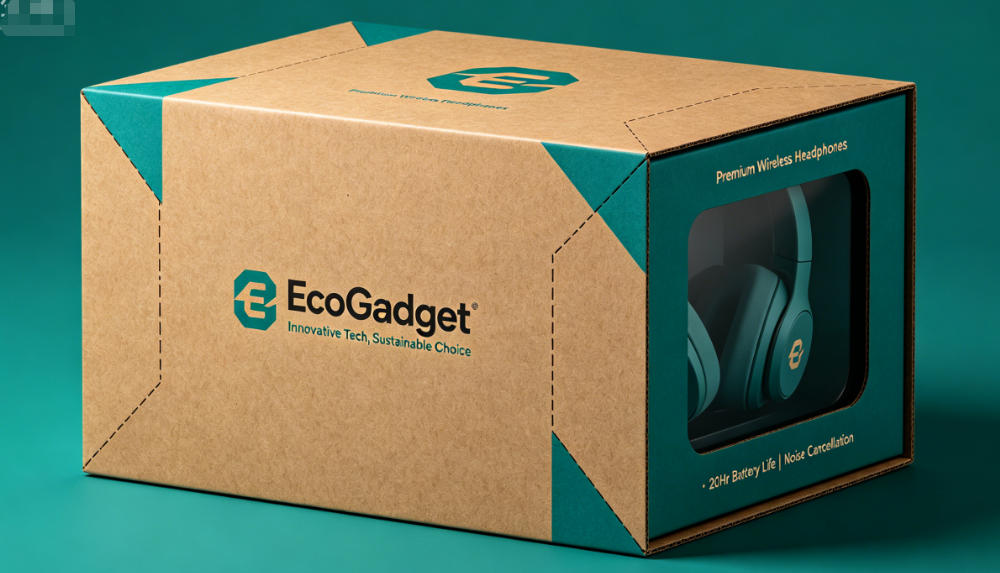
Your packaging does more than hold a product. It speaks before anyone reads a word. I learned this lesson the hard way ten years ago when a customer in Dubai opened a shipment and found dented corners on half the boxes. The product inside was perfect. But the packaging failed. That moment taught me that design is not just about looks. It is about the whole experience from factory floor to customer hands. Let me walk you through what I have learned since.
How to make awesome custom packaging boxes?
You order custom boxes and they arrive looking nothing like the sample. The color is off. The corners are weak. The unboxing feels cheap.
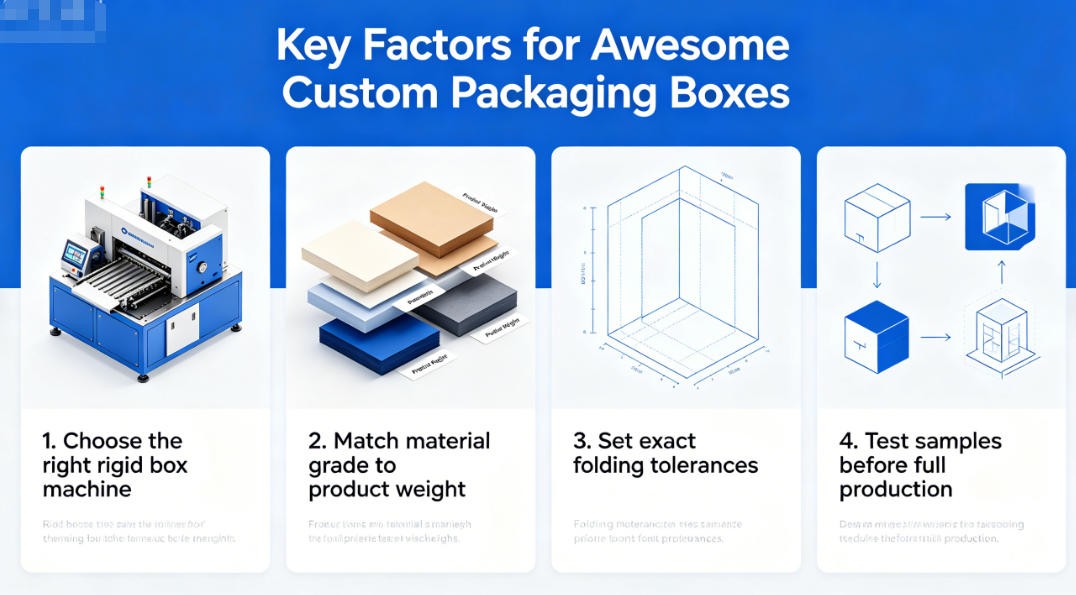
Awesome custom packaging boxes come from four things: choosing the right rigid box machine, matching material grade to product weight, setting exact folding tolerances, and testing samples before full production.
What makes custom boxes stand out from stock boxes
Custom boxes give you control. Stock boxes force your product to fit inside someone else's idea. Custom boxes wrap around your product like a tailored suit. I see this difference every day at our factory in Dongguan. A book publisher who switches from stock boxes to custom rigid boxes sees their return rate drop. A cosmetics brand that moves to custom magnetic closure boxes watches their shelf pickup rate climb.
| Design Factor | Stock Box | Custom Box |
|---|---|---|
| Fit | Generic, loose | Precise, snug |
| Brand room | Tiny logo stamp | Full print surface |
| Material choice | Limited | Any grade you need |
| Texture & finish | Standard matte/gloss | Hot stamping, embossing, soft-touch |
| Perceived value | Commodity feel | Premium experience |
The machine behind the box matters just as much as the design on paper. Our Ky-380 Hard Cover Making Machine handles gluing, board feeding, positioning, and edge folding in one pass. That kind of precision means the box you design is the box you get. No surprises.
What are the 5 P's of packaging?
You think packaging is just about the box. Then your product arrives damaged, or your brand gets lost on the shelf, and you wonder what went wrong.
The 5 P's of packaging are Product, Protection, Presentation, Practicality, and Price. They work together as a system. Miss one, and the whole package fails.
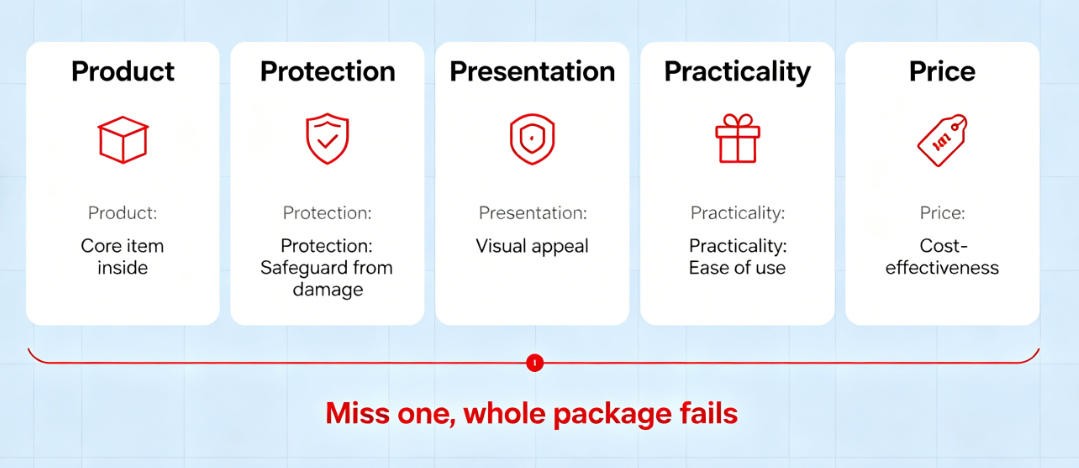
Breaking down each P and how they connect
I use the 5 P's as a checklist before I approve any packaging design. Here is how each one works.
Product. Start here. What are you putting inside the box? A heavy glass bottle needs a different box than a silk scarf. The product dictates the structure.
Protection. This is the non-negotiable P. I once saw a shipment of rigid boxes collapse because the paper weight was too low for the board thickness. The Slipcase Box Forming Machine we use at Kylin forms boxes with exact pressing pressure so the structure holds up in transit.
Presentation. This is where brand work happens. Color. Typography. Finish. Foil stamping. A good presentation makes the customer pick up the box. Our Pneumatic Hot Stamping Machine adds foil logos and patterns that catch light on the shelf.
Practicality. Can the customer open the box easily? Does it stack well in storage? Does it fit standard shipping cartons? A beautiful box that frustrates the user is a bad box.
Price. Every design choice has a cost. Board thickness adds durability but adds weight. Hot stamping looks premium but adds a production step. Balance is the goal.
| P | What to ask yourself |
|---|---|
| Product | What weight, shape, and fragility? |
| Protection | Will it survive shipping and handling? |
| Presentation | Does it stop the eye on the shelf? |
| Practicality | Is it easy to open, store, and ship? |
| Price | Does the cost match the perceived value? |
How to make a personalized box?
You want a box that feels like it was made just for your customer. But most "personalization" stops at printing a name on the lid.
A truly personalized box matches the unboxing rhythm to the buyer's expectation. It uses custom inserts, selected textures, brand-color interiors, and finishing touches like ribbon pulls or magnetic closures.
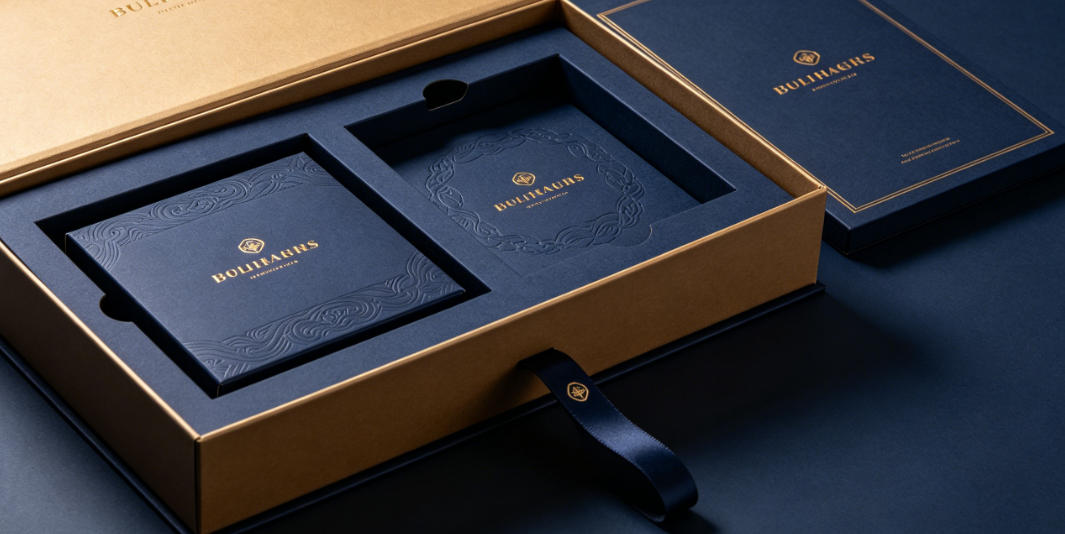
The three layers of personalization that customers actually notice
Personalization works on three levels. Most brands stop at level one. That is a mistake.
Surface personalization. This is the name on the lid. The custom print. The thank-you card inside. It is the easiest layer to add. It works. But it is shallow.
Structural personalization. This is where the box is built around the product. A custom insert that cradles a watch. A drawer-style box for a jewelry set. A book-style opening for a premium notebook. The Fully Automatic Box Folding Machine we make at Kylin folds boxes with servo-controlled wall positioning. That means crisp edges and tight corners every time. When a box fits perfectly, the customer feels the care before they even open it.
Experience personalization. This is the hardest layer to get right. It is about the rhythm of unboxing. How does the lid lift? Is there resistance? Does it slide or snap? Does the inside color surprise the customer? I remember designing a box for a tea brand in Turkey. We lined the interior with a gold foil that only became visible when the lid opened fully. The customer shared unboxing videos of that box for months.
| Personalization Layer | What it does | Machine needed |
|---|---|---|
| Surface | Prints, foil, embossing | Hot Stamping Machine |
| Structural | Custom inserts, tight fit | Box Folding Machine |
| Experience | Unboxing rhythm, reveal moments | Hard Cover Maker |
Can AI create packaging design?
You hear about AI designing logos and writing copy. You wonder if it can design your packaging too. You hope it saves you time and money.
AI can generate packaging concepts, color palettes, and layout variations in seconds. But it cannot test materials, feel textures, or understand manufacturing constraints. Use AI for ideas. Use machines for execution.
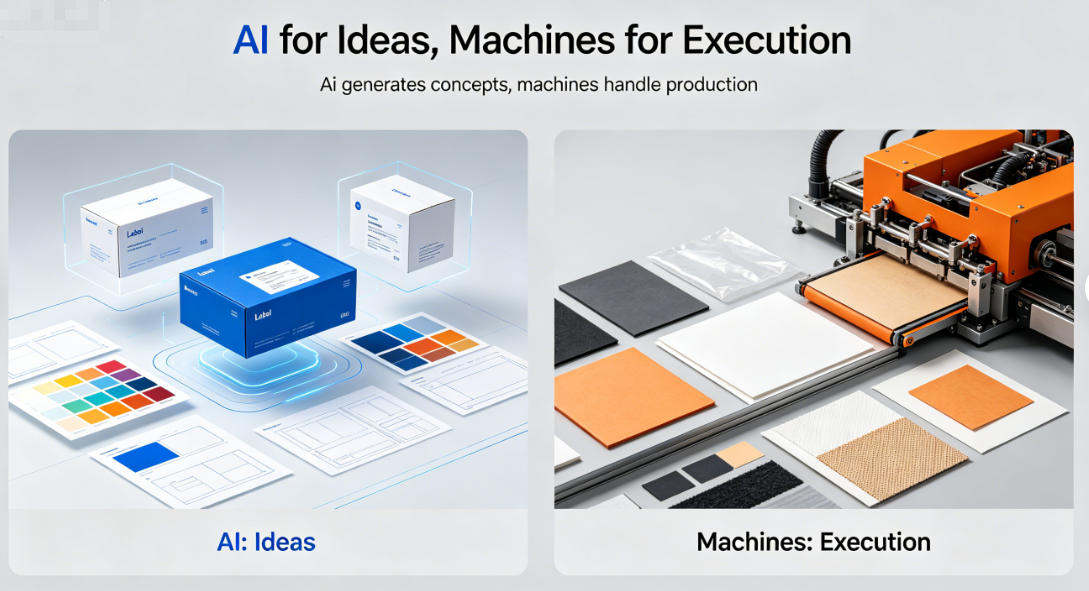
Where AI helps and where it falls short in packaging
I have tested AI tools for packaging design over the past year. Here is what I found.
AI is strong at idea generation. Give a tool like Midjourney a prompt and it gives you fifty packaging concepts in minutes. That used to take a designer days. AI is also good at pattern creation and color matching. It never gets tired. It never runs out of ideas.
AI falls short in three places. First, it does not understand manufacturing. A design looks beautiful on screen. But can that box be folded on a real machine? AI does not know. Our Fully Automatic Box Folding Machine works with specific material ranges. AI cannot factor that in. Second, AI cannot test. You cannot send an AI design to a focus group and watch real hands open the box. Third, AI cannot inspect. Our CCD Visual Anti-Mixing Detection Equipment checks barcodes, QR codes, patterns, and glue presence on finished boxes. AI design tools have no connection to this quality layer.
| Task | AI capability | Real-world gap |
|---|---|---|
| Concept generation | Excellent | Needs human curation |
| Color & pattern | Strong | Cannot match Pantone exactly |
| Dieline creation | Basic | Ignores machine tolerances |
| Material selection | None | No tactile understanding |
| Quality inspection | None | Requires CCD equipment |
My advice is simple. Use AI as your brainstorming partner. Then hand the design to a packaging engineer who knows what machines can actually do.
What are the 4 C's of packaging?
You hear about the 4 P's of marketing. Then someone mentions the 4 C's of packaging and you realize there is another framework you need to know.
The 4 C's of packaging are Customer needs, Cost, Convenience, and Communication. They shift the focus from the factory to the end user. The customer, not the production line, becomes the center.
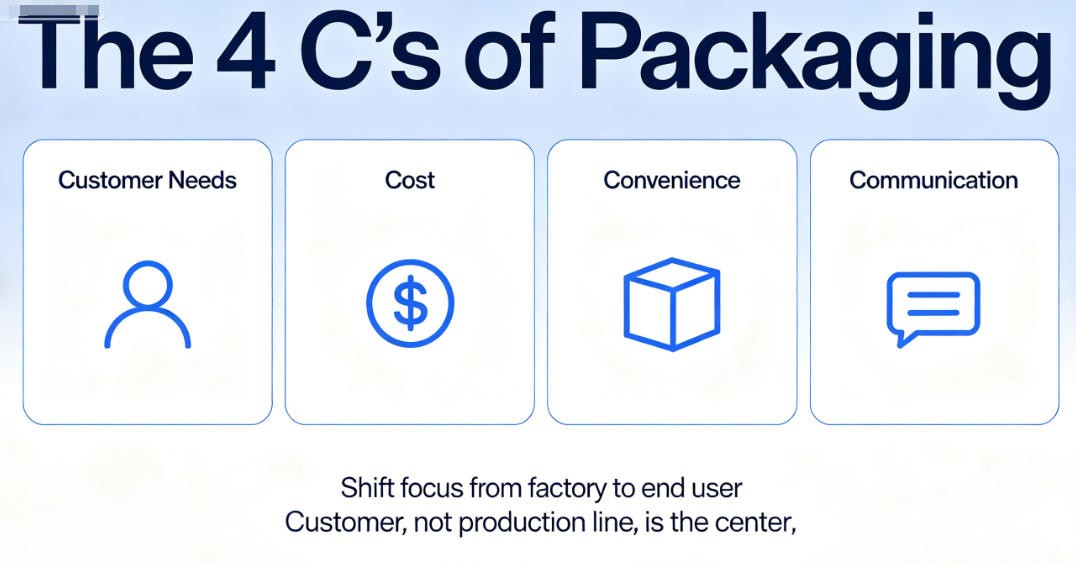
Why the 4 C's matter more than the 4 P's in today's market
The 4 P's of marketing put the seller at the center. The 4 C's flip the lens. They put the buyer at the center. In packaging, that change matters more than ever.
Customer needs replace Product. Stop asking what box you want to make. Start asking what the customer needs from the box. Do they need it to fit in a handbag? Do they need it to survive humidity in a warehouse in Mumbai? I ask my customers these questions before I recommend any machine. A publisher printing luxury photo books needs a different box solution than a factory packing mobile phone cases.
Cost replaces Price. Price is what you charge. Cost is what the customer pays in total. That includes the price of the box. But it also includes the cost of a box that is hard to open. The cost of a box that breaks and returns. The cost of a box that looks cheap and fails to sell the product.
Convenience replaces Place. Where the box is sold matters less than how easy it is to use. Can it be opened with one hand? Does it reseal? Can it be flattened for recycling? These convenience factors drive repeat purchases.
Communication replaces Promotion. The box itself is a communication channel. It speaks through color, texture, typography, and structure. Our Ky-380 Hard Cover Making Machine creates covers that communicate quality through precise edge folding and tight corners. The box does not need a salesperson. It sells itself.
| 4 C's | Question to ask |
|---|---|
| Customer needs | What does the buyer really need from this box? |
| Cost | What is the total cost to the customer, not just the price? |
| Convenience | How easy is the box to open, store, and dispose of? |
| Communication | What does the box say before anyone reads a word? |
Conclusion
Good packaging design blends customer insight, material choice, machine precision, and brand story into one box that protects the product and sells it fast.

发表回复