

Northend upgrades with a new Canon press — should your finishing keep up?
Your printer just got faster. Your finishing is now the slow point. Northend felt this when they upgraded their Canon press. Their fix shows you what to do next.
Northend is a UK print house. It runs Canon imagePRESS and Colorado presses. A new Canon press made more sheets. So it added fast finishing machines. The lesson is simple. More print speed means you need more post-press speed.
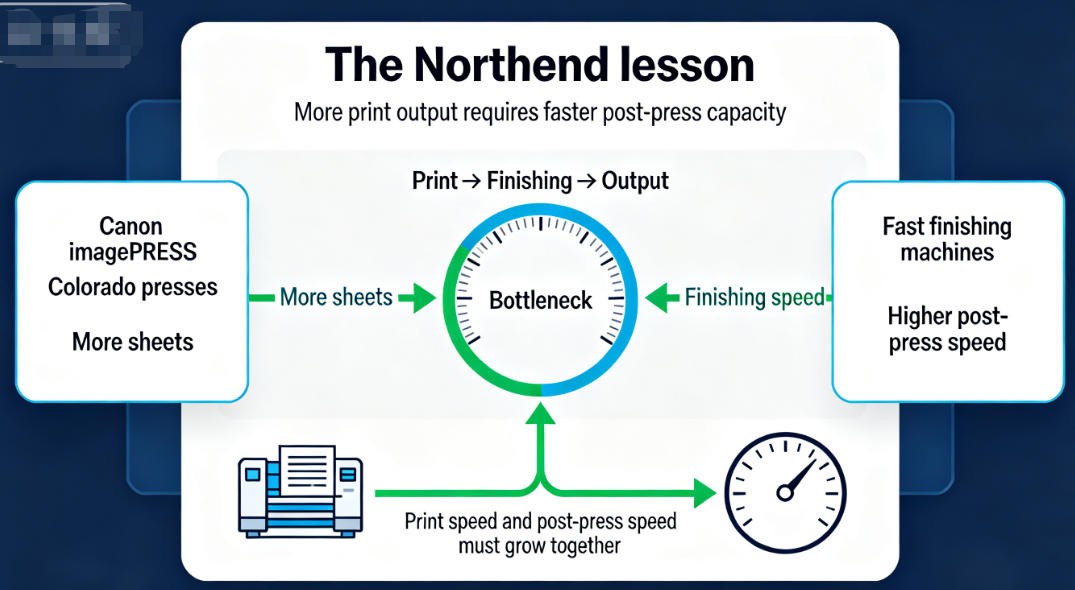
I have seen this many times. I run Kylin Machine. We build post-press machines in China. A client buys a new digital press. They smile for a month. Then the boxes and covers pile up. The press waits on the finishing line. This is the hidden cost of a press upgrade. Let me walk you through it.
Why does a Canon press upgrade always slow down your finishing?
You paid for more speed. You got more work. Now the cutting, folding, and gluing cannot keep up. Northend hit this exact wall. So they acted fast.
A faster press makes more sheets every hour. The old finishing steps still work at the old speed. So the press waits. Northend fixed this by adding automated cutters and creasers. Your line needs the same step up.
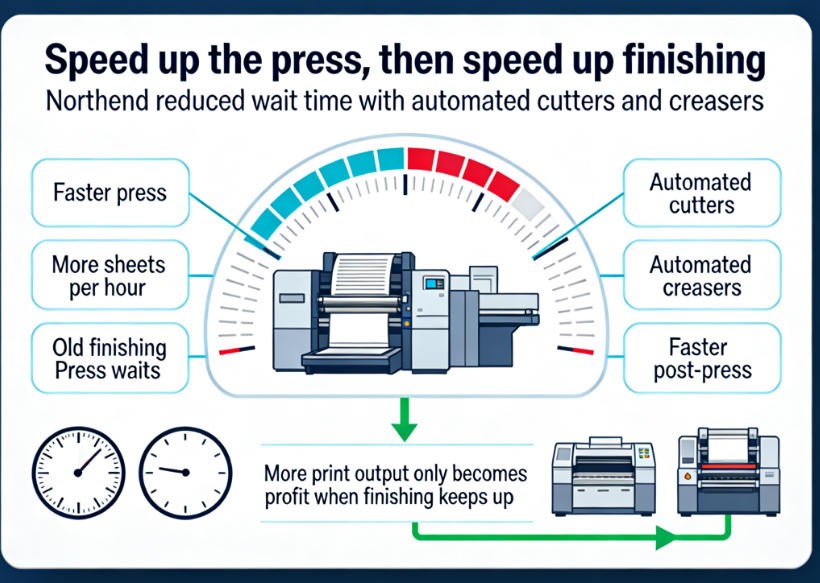
When a Canon press speeds up, it does not just print faster. It changes the whole job mix. Run lengths get shorter. More jobs need special shapes. The press feeds the finishing line all day. The finishing line must match.
Think of it as a pipe. The print side is now a wide pipe. The finishing side is still a narrow pipe. Water backs up at the joint. That is your pile of printed sheets.
Northend saw this. They added a Duplo DC-646 and a PFI Blade B2+. The DC-646 slits, cuts, creases, and perforates in one pass. The Blade cuts complex shapes in house. This removed the bottleneck.
Print speed versus finishing speed
| Step | Before upgrade | After upgrade |
|---|---|---|
| Printing speed | Fast Canon press | Same fast press |
| Cutting and creasing | Manual, slow | One-pass automatic |
| Special shapes | Sent out | Cut in house |
| Setup time | High | Low |
The same idea applies to rigid boxes and hard covers. A fast press prints covers quickly. The case-making step must keep up. That is why we build the Ky-380 hard cover making machine. It turns printed sheets into finished cases in one flow. You do not want your new Canon press waiting on a hand-made cover.
Can your hard cover and rigid box line keep pace with a new Canon?
Digital print made short runs easy. Now clients order 200 boxes, not 20,000. Your old box line is too slow for that. The margin dies in the changeover.
Short runs are the new normal. Your box line must change over in minutes, not hours. A semi-automatic wrapper handles many box sizes fast. It keeps your margin on small orders.
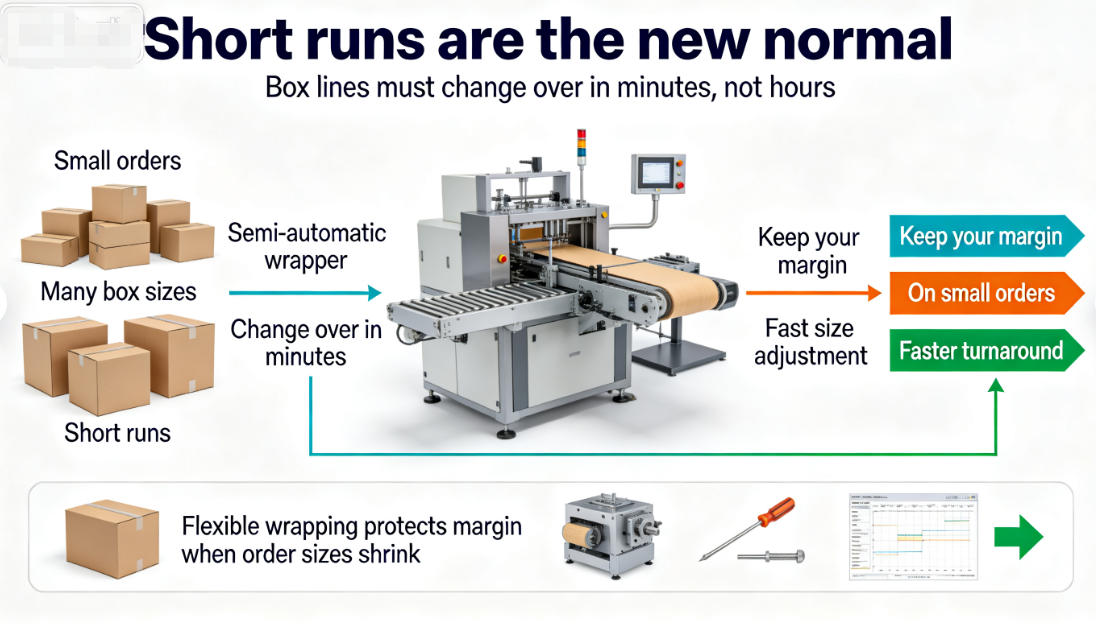
Short runs change how you make rigid boxes. An old machine is set for one box size. It takes an hour to change. With short runs, you spend more time on setup than on making. That kills your profit.
This is where automation helps. Our Semi Auto Polygon Rigid Box Wrapper wraps many box shapes. It changes fast. Our Auto Rigid Boxes Machine handles the full run on its own.
Book covers are the same story. Digital presses like the Canon imagePRESS print covers in small batches. Your case maker must switch quickly. The Ky-380 hard cover making machine is all-in-one. It folds, glues, and cases in one flow. It cuts your labor and your errors.
Then there is the finish. A premium book or box needs gold on the edge. Our edge gilding machines add that luxury fast. This lets you sell a higher price per piece. If your box line does not rise with the press, the extra speed turns into a bigger pile of half-done work.
Should you automate post-press before your next press upgrade?
You are about to spend big on a press. Wait. Look at your finishing first. If it is manual, the new press will only make the wait longer.
Automate post-press first. It costs less than a press. It removes the real bottleneck. Then the new Canon press runs at full speed from day one. You get the return you paid for.
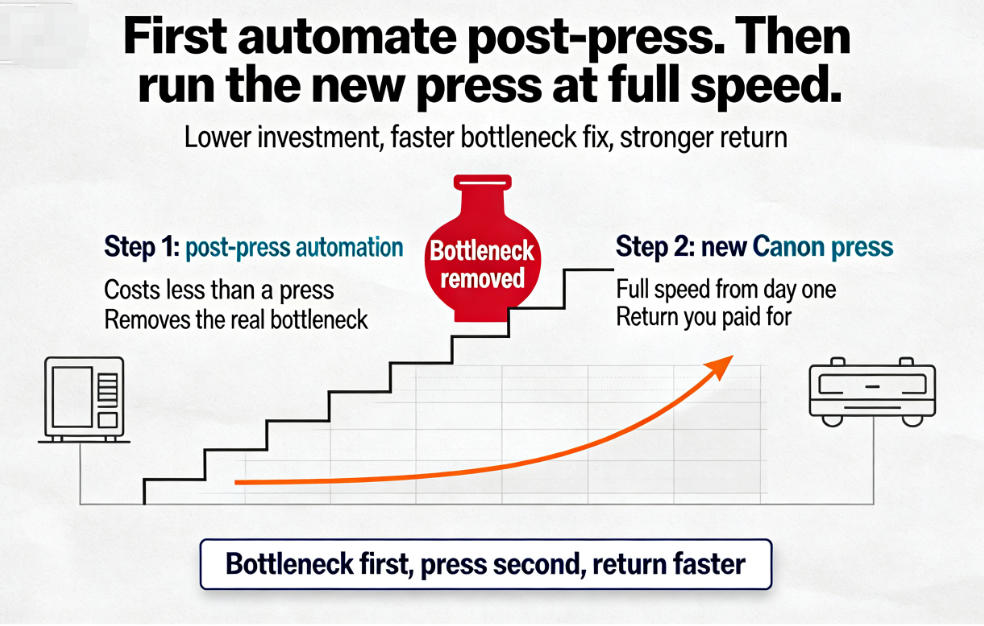
Here is the order I tell every client. Fix the bottleneck before you add the volume. That means post-press first. It is cheaper than a press. And it is where the profit hides.
Start with the glue. Our Glue Spraying Assembly Machine puts glue on boxes and covers with no mess and no waste. Manual gluing is slow and uneven. This machine fixes both.
Next, check the quality. Fast lines make fast mistakes. Our CCD Visual Anti-Mixing Detection Equipment checks each box. It catches the wrong lid or the wrong insert before it ships. One bad batch can cost more than the machine.
Now look at the whole flow. The book cover machines and the rigid box machines cover the main work. Add the small machines for the edges and folds. Together they remove the hand work.
I have watched clients do this. They automate finishing. Then they buy the new press. The new press runs from the first day. There is no pile. No overtime. No rush. That is the smart order.
If you are thinking about a Canon upgrade, or any new press, talk to us first. Tell us your mix of boxes, covers, and runs. We will show you the machines that fit. My name is Jacob, and you can reach us at postpressmachines.com.
Conclusion
A new Canon press only pays off when your finishing keeps up. Automate post-press first. Then your speed turns into shipped boxes, not a pile of work.

发表回复