
What material is a cardboard box?
Every day, millions of boxes ship across the world. But the material inside those boxes is almost invisible to us. We see the product, not the package. So what exactly is a cardboard box made of?
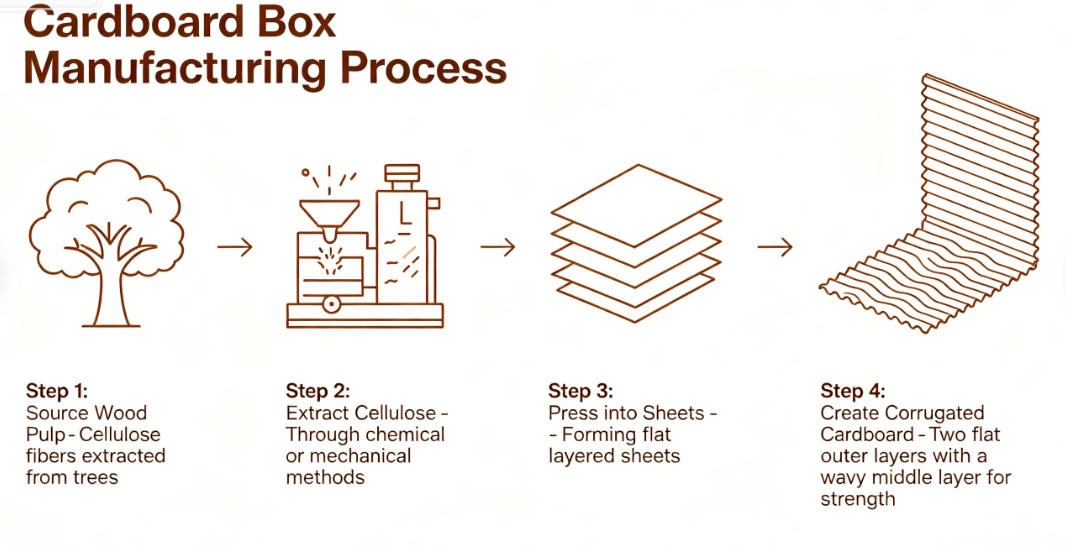
A cardboard box is made from wood pulp — cellulose fibers extracted from trees through chemical or mechanical processing, then pressed into layered sheets. The most common type, corrugated cardboard, has two flat outer layers with a wavy middle layer for strength.
I have spent 20 years building machines that turn flat sheets of cardboard into finished boxes. My name is Jacob, and I run Kylin Machinery in Dongguan, China. Every machine we ship to customers in 20 countries depends on one thing — understanding the material it processes. So let me walk you through what cardboard really is.
What are cardboard boxes made of?
You see cardboard boxes everywhere. Shopping deliveries, moving house, product packaging. But if I handed you a piece of corrugated board and asked you to name every part of it, would you know what to say?
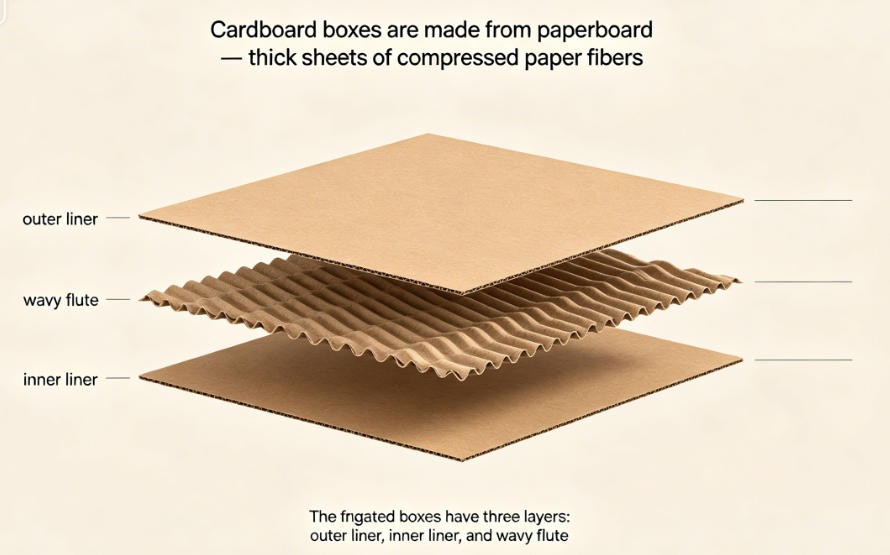
Cardboard boxes are made from paperboard — thick sheets of compressed paper fibers. Corrugated boxes have three layers: an outer liner, an inner liner, and a wavy flute in between. The flute is the secret to the box's strength and cushioning.
The journey starts with trees. Softwood trees like pine and spruce work best because their fibers are long and strong. The logs go through a debarker, then into a chipper that reduces them to small pieces. These wood chips enter a pressure cooker called a digester. Inside, chemicals like sodium hydroxide break down the lignin that holds wood together. After several hours of cooking, what comes out is a brown slurry of loose cellulose fibers.
This pulp gets washed to remove the chemicals. Some pulp gets bleached white. Most stays brown for box-making because bleaching costs money and the brown color works fine for shipping boxes. The wet pulp then spreads onto a moving screen where water drains away. Heated rollers press and dry the thin sheet into paper.
For corrugated board, the process continues. The middle layer runs through heated corrugating rolls that press it into a wave shape. Glue gets applied to the tips of those waves. Then the flat outer layers get pressed onto both sides. The result is a rigid, lightweight board that can hold surprising weight.
Here is how the different flute types compare:
| Flute Type | Thickness | Flutes per Meter | Best Used For |
|---|---|---|---|
| A-Flute | 4.7 mm | 105-125 | Heavy items, stacking strength |
| B-Flute | 2.5 mm | 150-185 | Die-cut boxes, printing surface |
| C-Flute | 3.6 mm | 120-145 | General shipping, most common |
| E-Flute | 1.2 mm | 290-320 | Retail packaging, fine printing |
| F-Flute | 0.8 mm | 400+ | Luxury boxes, small products |
When customers visit our factory to look at box-making machines, the first thing I ask is what kind of board they plan to run. A machine set up for B-flute will not handle A-flute the same way. The thickness changes everything — glue amount, folding pressure, conveyor speed. I learned this the hard way during a machine installation in Turkey five years ago. The customer brought in extra-thick board on day one, and we spent six hours adjusting every setting on the machine before it ran smoothly.
Is cardboard technically wood?
Words matter. When someone calls cardboard "wood," they are not entirely wrong — but they are missing something important about what happens during manufacturing.
Cardboard is not technically wood. It is a paper product made from separated and reconstituted wood fibers. The pulping process removes the lignin that gives wood its rigid grain structure. What remains is pure cellulose reformed into flat sheets.
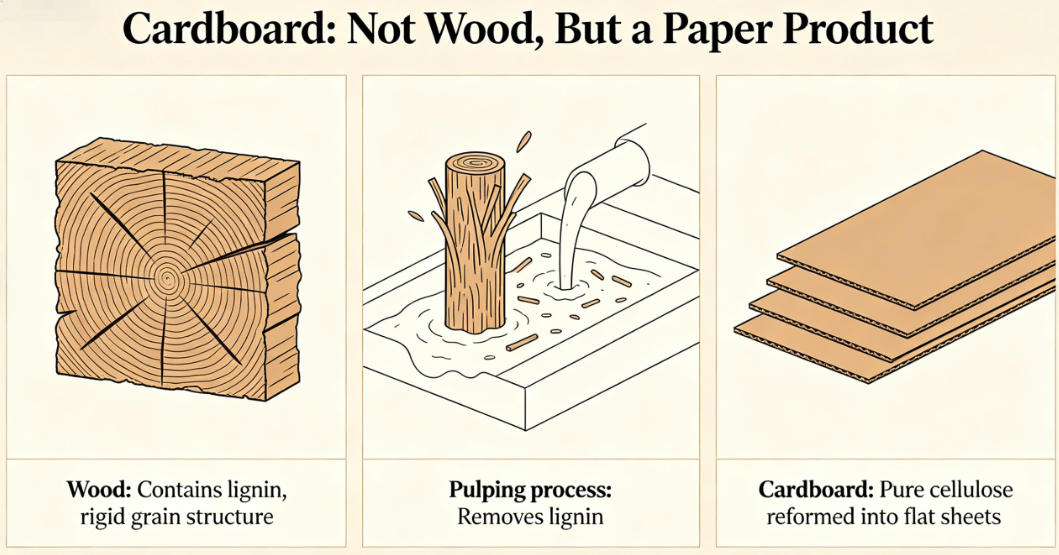
Wood has grain. It has rings. It splits in predictable directions. If you take a plank of pine and try to fold it, it snaps. Cardboard bends. It creases along straight lines. It can be scored, folded, and wrapped around corners without breaking. The difference is not just in shape — it is at the molecular level.
The Kraft pulping process removes about 90% of the lignin from wood. Lignin is the natural polymer that acts like glue inside tree cells. When you remove it, the cellulose fibers no longer hold together as a solid block. They become a loose, flexible mass that can be rearranged in any direction. This is why paper and cardboard are flat and uniform. Wood has direction. Cardboard does not.
At our hard cover making machine assembly line, we bond different paper materials together every day. Grey board, chipboard, Kraft liner, coated paper — these all came from trees but behave nothing like wood. Grey board is stiff but has no grain direction. Kraft liner is strong in tension but tears easily. Each material needs different handling. A wood plank would shred itself in any of our machines within seconds.
So yes, cardboard comes from trees. But calling it wood is like calling a cotton T-shirt a cotton plant. The starting point is the same. The end product is completely different.
Is cardboard eco-friendly?
Green labels confuse customers. Some say cardboard saves the planet. Others say it destroys forests. Who should you believe?
Cardboard is one of the most eco-friendly packaging materials available. It comes from renewable trees, it recycles at rates above 85-90%, and it biodegrades within months when disposed. The main environmental concerns are water usage in pulping and energy consumption in manufacturing.
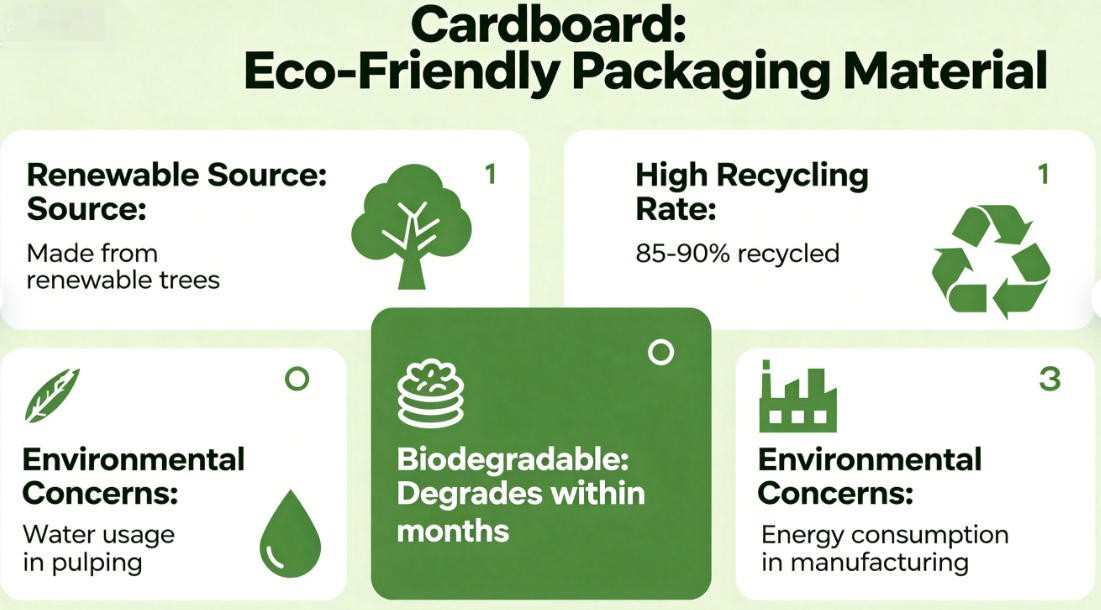
I cannot pretend the cardboard industry has no environmental impact. We use trees. We use water. We use electricity. But I have seen the full supply chain from forest to finished box, and I believe cardboard holds up well against every alternative.
Let me start with the good news. Trees are a renewable resource. The wood in your cardboard box came from managed plantations, not ancient forests. In China and across Asia, fast-growing species like eucalyptus and poplar supply the pulp industry. These trees reach harvest age in 7 to 15 years. New trees get planted to replace them. The cycle continues.
Recycling is the cardboard industry's biggest strength. Old corrugated containers — what the industry calls OCC — are collected, sorted, and sent back to paper mills. The fibers get re-pulped and turned into new board. A single fiber can be reused five to seven times before it gets too short and weak. Fresh pulp is always blended in to maintain strength. This is why so many boxes have the recycling symbol on them. It is not greenwashing — cardboard recycling actually works at scale.
Biodegradability matters too. A cardboard box left outside in the rain will break down in weeks. Buried in a landfill, it decomposes in two to six months depending on conditions. It turns into compost. It does not leave behind microplastics. It does not leach toxic chemicals.
The downsides are real but manageable. Pulp mills use enormous amounts of fresh water — though modern mills recycle most of it in closed-loop systems. The cooking process uses chemicals that must be treated before discharge. Transport adds carbon emissions at every stage. And demand for cardboard keeps growing as e-commerce expands.
Compare these problems to plastic. Plastic comes from oil. It does not biodegrade. It accumulates in the environment forever. Only a small fraction gets recycled. When you look at the options side by side, cardboard wins. This is why our customers keep investing in equipment like our glue spraying assembly machine — the demand for paper-based packaging keeps rising year after year.
Is cardboard made out of plastic?
Some boxes look glossy. Some feel waxy. Some have a smooth, almost plastic-like surface. These boxes create confusion. Are they part-plastic?
Standard brown corrugated cardboard contains no plastic at all. It is 100% paper fiber with starch-based glue. However, specialty boxes may have a thin polyethylene coating or a laminated plastic film for moisture resistance, grease barriers, or glossy appearance.
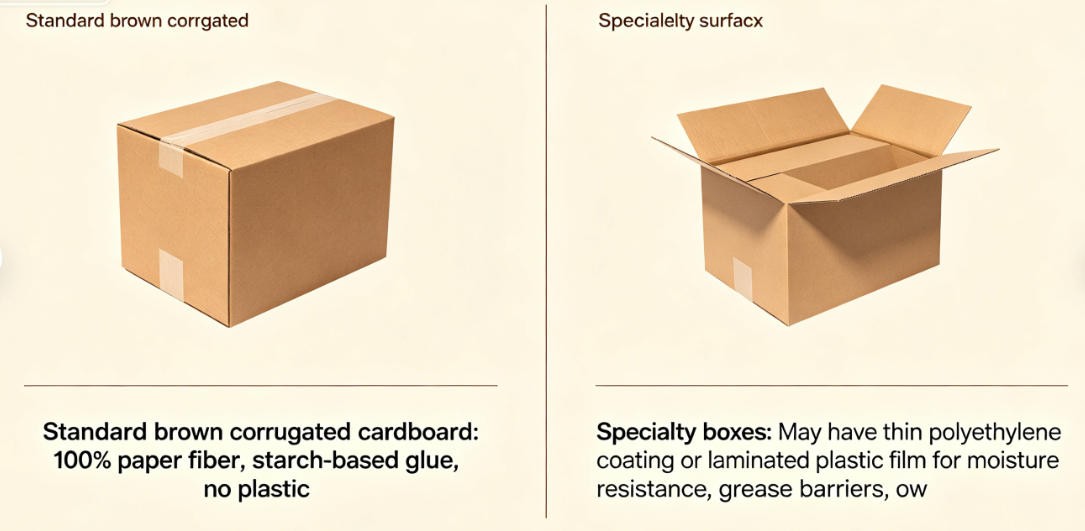
The confusion is understandable. Walk down a supermarket aisle and you will see boxes that shine under the lights. Frozen food boxes. Juice cartons. Premium gift boxes with metallic finishes. These are not plain cardboard. They are composite materials — paper with something else added on top.
Plain Kraft corrugated boxes are pure paper from start to finish. The brown color is natural — no dye, no coating, no plastic. The glue that holds the layers together is usually corn or wheat starch mixed with water. Nothing synthetic. These boxes can go straight into paper recycling without any special processing. Our rigid box machines produce packaging that uses only paper, board, and water-based adhesive. No plastic enters the process.
But some industries need boxes that resist moisture. Food packaging is the biggest example. Frozen pizza boxes. Butter cartons. Takeaway containers. These have a thin layer of polyethylene — essentially plastic — applied to the paper surface. The coating stops liquids from soaking in and making the box soggy. The problem is that this thin plastic layer makes the box much harder to recycle. Most municipal recycling programs cannot separate the materials.
Laminated boxes present the same challenge. A glossy gift box often has a transparent plastic film heat-pressed onto the outer surface. The film makes colors pop and gives the box a premium feel. But the film is plastic. And when the box reaches end-of-life, that plastic film must be peeled away or the whole box goes to landfill.
Things are changing. Water-based barrier coatings are improving fast. These coatings use modified starches or plant-based polymers to create moisture resistance without any plastic. I tested one of these new coatings at our factory last year. Water beaded up on the surface just like it would on plastic. But the box was still 100% paper-recyclable. The technology is not perfect yet — it costs more and does not match plastic's performance in freezing conditions. But it is getting better every year.
The simplest rule for spotting plastic in cardboard is the water test. Put a drop of water on the surface. If it soaks in, it is just paper. If it beads up, there is something else there.

发表回复