

How Many Types of Packaging Boxes Are There?
Your product sits on a shelf next to a dozen competitors. The only thing between a customer picking yours or theirs is the box it comes in. Get it wrong, and you lose the sale in seconds.
Packaging boxes fall into 7 main categories: folding cartons, rigid boxes, corrugated boxes, paperboard boxes, plastic boxes, wooden boxes, and specialty boxes. Each type serves a different purpose from protection to presentation.
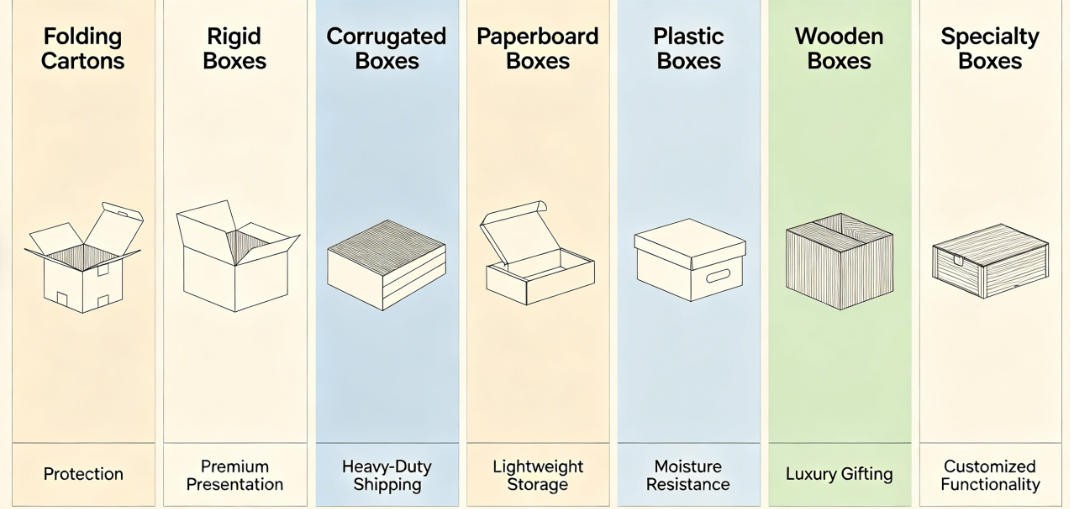
I learned this lesson 20 years ago when I visited a bookbindery in Guangzhou. They were using the wrong type of box for a premium photo album. The corners crushed during shipping, and the customer sent the whole batch back. That was the day I understood that choosing the right packaging box is not a matter of cost alone. It is a matter of knowing exactly what each box type does and matching it to the job at hand.
How Many Types of Retail Boxes Are in the Packaging World?
Walk into any department store and you are surrounded by boxes. Most of them look different on the outside, but they all fall into just a few construction types. You probably never noticed the pattern.
There are about 12 main types of retail boxes that cover most store shelves. These include folding cartons, rigid boxes, corrugated display boxes, blister packs, clamshells, window boxes, sleeve boxes, two-piece boxes, tuck-top boxes, auto-bottom boxes, shoulder boxes, and specialty gift boxes.
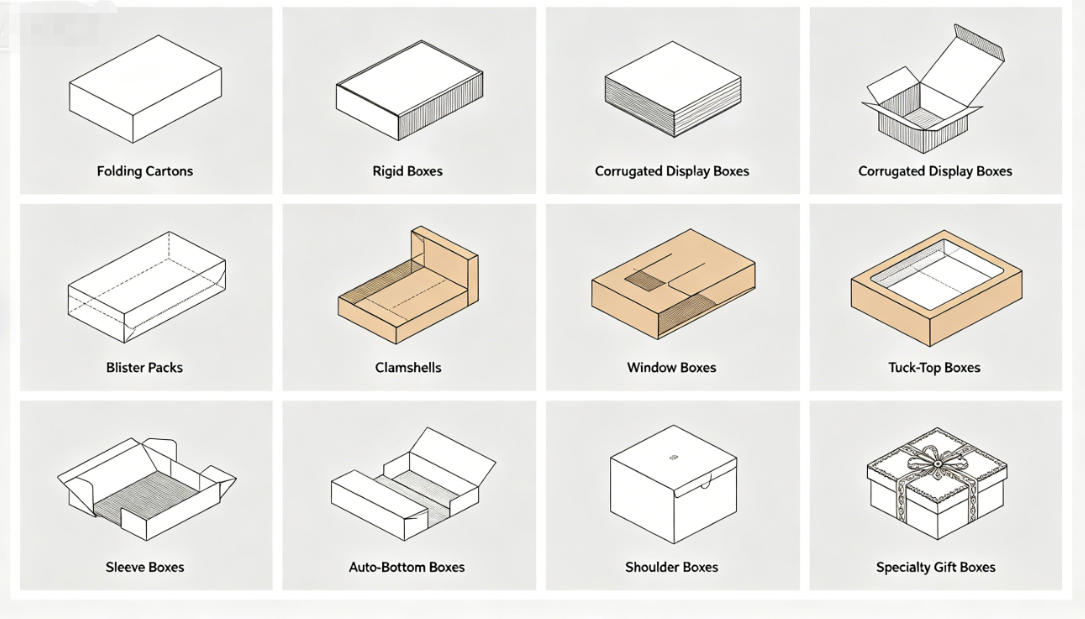
When I help our customers at Kylin Machinery pick a machine for their retail packaging line, I always start with the same question: who is your end buyer? The answer tells me which box type they need. A cosmetics brand selling at a high-end counter needs a different box than a snack company selling at a supermarket. Retail boxes do more than just hold things. They communicate price, quality, and brand personality all at once.
Why Retail Box Types Matter More Than You Think
The type of retail box you pick changes everything. It changes your shipping cost. It changes how your product sits on a shelf. It changes whether a customer feels excited or disappointed when they open it.
| Box Type | Best For | Key Feature | Typical Material |
|---|---|---|---|
| Folding Carton | Food, medicine, light items | Ships flat, easy to store | Paperboard |
| Rigid Box | Luxury goods, electronics, books | Premium feel, very strong | Grey board + wrapped paper |
| Corrugated Box | Shipping, bulk retail | High crush resistance | Corrugated fiberboard |
| Window Box | Display products like toys, pastries | Customer sees the product | Paperboard with PVC/PET window |
| Sleeve Box | Gift items, premium retail | Elegant sliding mechanism | Rigid board |
| Two-Piece Box | Shoes, clothing, gifts | Separate lid and base | Corrugated or rigid board |
I once visited a small soap maker in Turkey who was shipping her artisan soaps in thin folding cartons. The boxes came apart during delivery. She switched to rigid boxes made with one of our rigid box machines and her return rate dropped from 12% to under 2% in three months. The box itself became part of the brand experience. This is why getting the type right matters from day one.
What Are the Different Types of Retail Packaging?
Every product category has its own packaging tradition. But traditions change. New materials and new machines make new box styles possible every year. The smart manufacturer stays ahead of what is possible.
Retail packaging falls into primary packaging that touches the product, secondary packaging that groups units together, and tertiary packaging used for shipping. Within retail, the main styles are cartons, rigid boxes, flexible pouches, blister packs, and thermoformed trays.
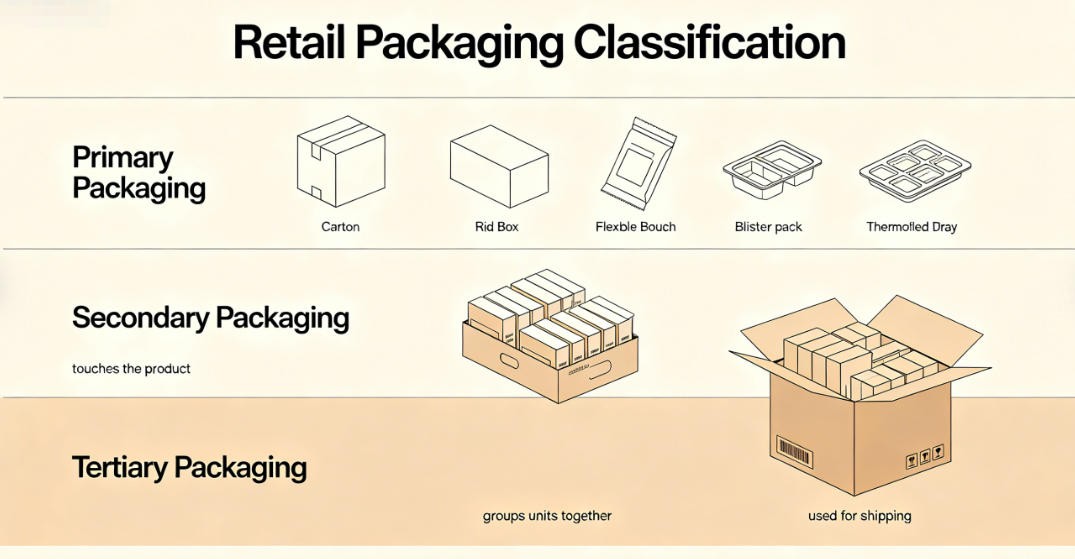
A packaging buyer from India once told me he felt lost every time he walked through a packaging expo. Too many options. Too many salespeople. I told him to ignore the noise and focus on three things: what his product weighs, how far it ships, and what his customer expects to see when they open it. Answer those three questions and the right packaging type falls into place.
Breaking Down Packaging by Function
Retail packaging serves three masters at the same time. First it must protect the product. Second it must sell the product on the shelf. Third it must not cost more than the product is worth. Every box type balances these three jobs differently.
Paperboard cartons are the most common in retail. They are light, cheap, and print beautifully. Our customers who run bookbinding operations often pair them with our KY-380 Hard Cover Making Machine when they also need to produce premium hard covers alongside standard cartons. The combination covers both ends of the market.
Rigid boxes are the premium choice. They are thick, heavy, and feel substantial in the hand. A rigid box tells the customer this product is special before they even see the product. Our Semi-Auto Polygon Rigid Box Wrapper lets mid-sized shops produce these luxury boxes without the cost of a fully automated line.
Corrugated boxes are the workhorses. They are not pretty, but nothing beats them for protective strength. Many retail products ship inside corrugated master cartons that contain smaller consumer-facing cartons inside. The Connected Box Machine we make handles this dual-layer need efficiently.
Specialty formats like slipcase boxes and magnetic closure boxes are growing fast. The Slipcase Box Forming Machine and the Multi-Function Iron Sheet & Magnet Machine are two of our fastest-growing products right now because more brands want packaging that doubles as a keepsake.
How Many Different Boxes Are There?
If you count every variation ever made, the number is endless. But if you count by structural engineering category, the list gets shorter and much more useful. I learned this from a packaging engineer who worked in our factory for six months, training our team.
Packaging engineers recognize about 30 structurally distinct box designs when classified by folding patterns, closure mechanisms, and assembly methods. The most common commercial variations used in production total around 15 standard box styles.
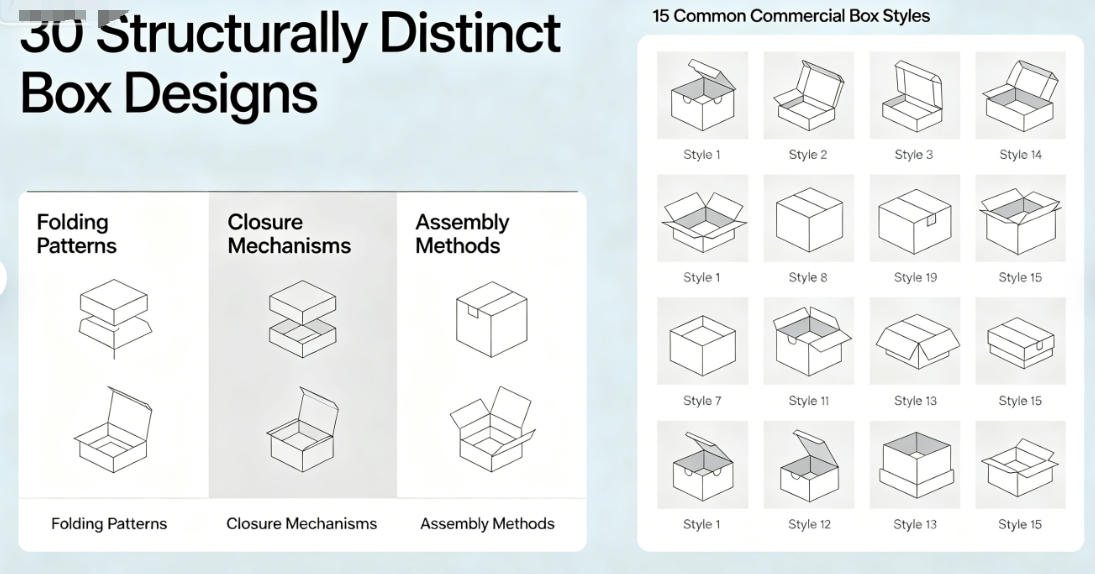
A distributor in Portugal once asked me for a single machine that could make every possible box. I had to tell him no such machine exists. But I also showed him that most boxes in real commercial use are just variations on a few simple patterns. Once you master the basic folds and joints, you can build almost anything.
Standard Box Styles in Industrial Production
The packaging industry uses standard ECMA and FEFCO codes to classify box designs. These codes turn a chaotic world of box shapes into something you can order, specify, and produce at scale. Here is what matters in practice.
| ECMA Code | Box Style | Common Use | Production Method |
|---|---|---|---|
| A (Cartons) | Straight tuck, reverse tuck, seal end | Pharmaceuticals, cosmetics, dry food | Folding and gluing line |
| B (Trays) | 3-point, 4-point, 6-point glued trays | Meat, produce, electronics inserts | Tray forming machine |
| C (Sleeves) | Open sleeve, closed sleeve | Bottles, multi-packs | Sleeve wrapping |
| D (Rigid) | Shoulder box, hinged lid, telescope | Luxury goods, books, gift sets | Case making + wrapping |
The FEFCO system for corrugated boxes adds another 70+ codes. But most factories only need maybe 10 of them. The rest are special orders that come around once a year. I always advise new box manufacturers to start with 5 standard styles and do them perfectly rather than trying to offer everything at once.
Our Fully Automatic Box Folding Machine handles the common folding carton styles at production speed. For rigid boxes, our Auto Rigid Boxes Machine 2025 Version covers the full range from basic two-piece boxes to complex magnetic closure designs. The Box Edge Inner Wrapping Machine takes care of the finishing details that turn a plain box into a premium presentation piece.
What Are the 5 P's of Packaging?
Marketing textbooks love frameworks. But the 5 P's is one framework that actually earns its place. It forces you to think about packaging as a system rather than just a container. I have used it with every new customer since 2010.
The 5 P's of packaging are Product, Protection, Presentation, Performance, and Price. They work together as a decision checklist. Skip any one of them and the packaging fails, no matter how good the other four are.
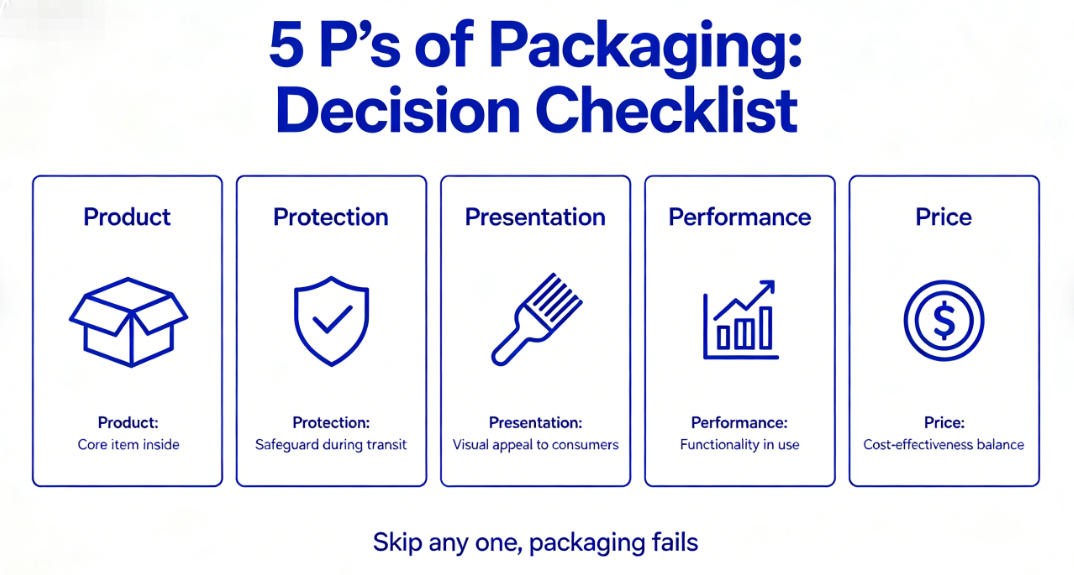
A customer from Italy once asked me why his beautiful rigid boxes were failing in the market. The boxes looked great. The protection was solid. The price was fair. But we discovered the product inside did not fit properly. We had skipped the first P. The box dimensions were wrong for the product. That simple mistake cost him six months of sales.
Applying the 5 P's to Real Box Production
Each P in the framework asks a question you must answer before you order a single box or set up a production line. Here is how I break it down for my customers.
Product asks: what goes inside? The weight, shape, fragility, and size of the product determine everything else. A Jewelry Rubber Box Assembling Machine produces very different boxes from a Large Box Pressing Machine because the products inside are completely different.
Protection asks: how will this survive the journey? Drop tests, vibration tests, compression tests. These are not optional. Our Automatic Thumb Cutting Machine adds opening features but never at the cost of structural integrity.
Presentation asks: what feeling does the box create? This goes beyond graphics. The texture, the weight, the sound the lid makes when it closes. Premium boxes made on our Semi-Auto Polygon Rigid Box Wrapper sell themselves purely on presentation.
Performance asks: does the box work every time? A box that fails one time in a hundred fails every time for that one customer. Automated machines like our Fully Automatic Bagging Machine give you the consistency that manual production cannot match.
Price ties it all together. The best box in the world is useless if the customer will not pay for it. That is where scalable production matters. Start small with a Desktop Glue Painting Machine and grow into a High-Speed Glue Painting Machine when the orders justify it.
Conclusion
The right packaging box is not the cheapest or the most beautiful. It is the one that fits the product, protects it through the supply chain, sells it on the shelf, works every time, and costs what the market will bear. Master the 7 main box types and the 5 P's and you master packaging.
About the Author
I am Jacob, founder of Kylin Packaging Machinery. Since 2003, my factory in Dongguan, China has been designing and building post-press machines for rigid box and hard book cover production. We serve over 2,500 customers across more than 20 countries through our factory and our distributor network in Turkey, Korea, Portugal, the UK, India, the USA, Italy, Canada, and the Middle East.
Recommended Products for Your Packaging Line:
| Machine | Application | Learn More |
|---|---|---|
| KY-380 Hard Cover Making Machine | All-in-one case making for hard covers | View Details |
| Auto Rigid Boxes Machine 2025 | Full automatic rigid box production | View Details |
| Semi-Auto Polygon Rigid Box Wrapper | Flexible production for premium boxes | View Details |
| Fully Automatic Box Folding Machine | High-speed folding carton production | View Details |
| Slipcase Box Forming Machine | Specialized slipcase production | View Details |
| Box Edge Inner Wrapping Machine | Premium finishing for luxury boxes | View Details |
| Connected Box Machine | Dual-layer box production | View Details |
| Jewelry Rubber Box Assembling Machine | Precision assembly for jewelry boxes | View Details |
| Large Box Pressing Machine | Heavy-duty pressing for oversized boxes | View Details |
| Multi-Function Iron Sheet & Magnet Machine | Magnetic closure box production | View Details |
Contact us today for a custom quote. Let us help you find the right machine for your packaging production needs.

发表回复