

How does Kornit’s All-Inclusive Click support hybrid screen printing and DTG?
Screen printing earns money on big orders. But small, colorful orders kill your margin. Kornit's All-Inclusive Click removes that pain and lets one shop run screen printing and DTG together.
The All-Inclusive Click is a pay-per-print plan. One flat rate covers ink, service, parts, and printheads. You pay only for what you print. So a shop keeps screen printing for long runs and adds DTG for short, detailed jobs.
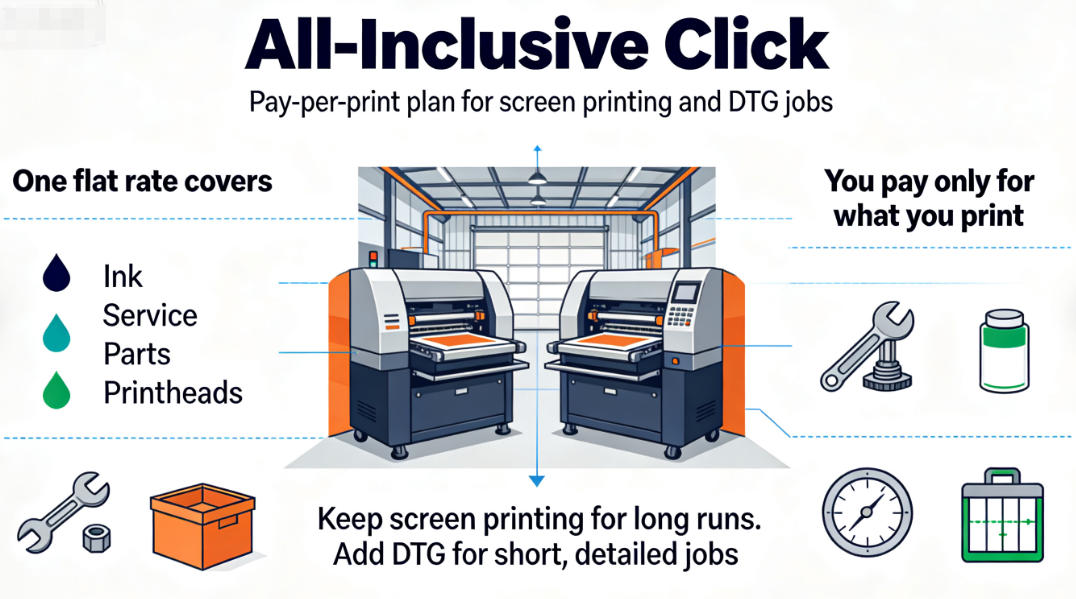
I build post-press machines in Dongguan, China. I talk to print shop owners every day. Most of them tell me the same thing. They fear buying a new machine. They fear the cost. But a flat per-print price changes that fear. Let me show you how.
Why does hybrid screen printing and DTG make sense for short runs?
Long runs love screen printing. Short runs do not. Each screen costs time and money to make. Digital printing removes that setup cost for small orders.
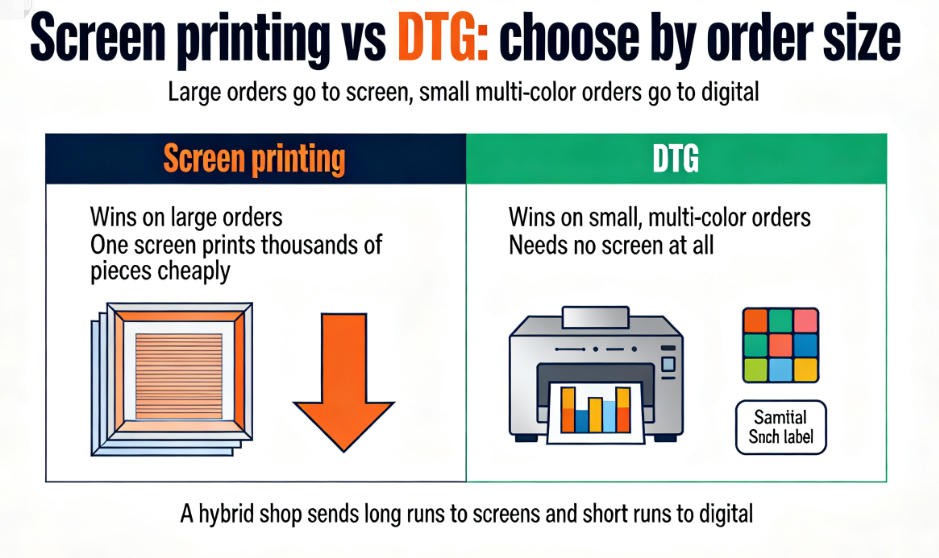
Screen printing wins on large orders because one screen prints thousands of pieces cheaply. DTG wins on small, multi-color orders because it needs no screen at all. A hybrid shop sends long runs to screens and short runs to digital.
The cost of a screen
Screen printing has a setup cost. You burn a screen for every color. That work takes time. You also pay for film and emulsion. On a ten-piece order, that cost is huge per piece. On a ten-thousand-piece order, that same cost is tiny per piece. So the math changes with the size of the job.
The digital answer
DTG prints straight from a file. There is no screen. You can print one shirt with twenty colors. The cost per shirt stays flat. So DTG fits small runs, samples, and one-off designs.
| Order type | Screen printing | DTG | Hybrid |
|---|---|---|---|
| Long run, few colors | Best | Slow | Send to screen |
| Short run, many colors | Expensive | Best | Send to DTG |
| Samples and proofs | Slow | Fast | Send to DTG |
The same rule works in packaging. A hybrid shop still needs a finishing line that keeps up. Our rigid box and case maker handles both rigid boxes and hard book covers in one machine.
How does the all-inclusive click pricing lower your risk?
Buying a digital printer feels risky. The machine is expensive. The ink is expensive. The click plan spreads that cost so a shop can start small.
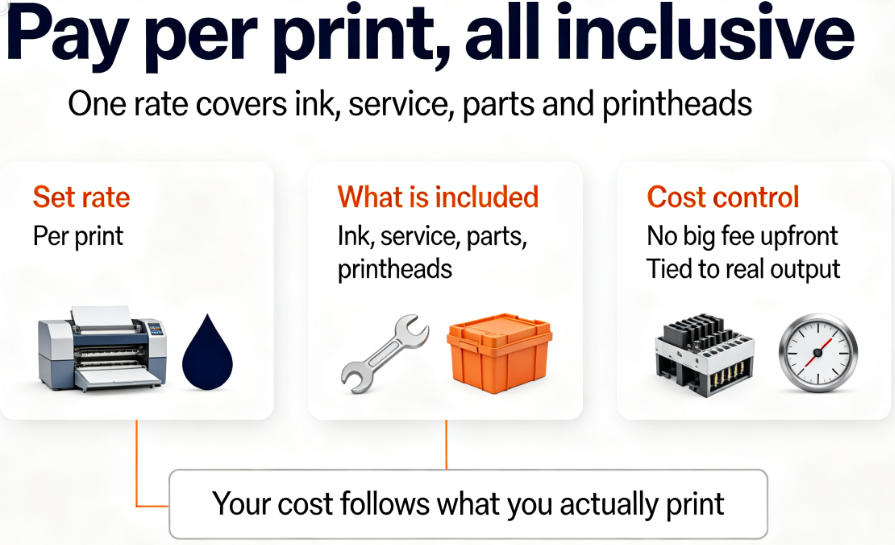
With All-Inclusive Click, you pay a set rate per print. Ink, service, parts, and printheads are all in that rate. You do not pay a big fee upfront. Your cost stays tied to your real output.
Fixed costs scare small shops
A digital printer has a big sticker price. It also has running costs. Ink, printheads, and service add up. A small shop cannot always see the payback. So it waits. It loses short-run orders while it waits.
The click model removes the guess
The click plan turns all those costs into one number. You know your cost per print before you quote a job. You can price a job the same day. You can add DTG next to your screen press with no big down payment.
| Cost item | Buy outright | All-Inclusive Click |
|---|---|---|
| Machine price | High upfront | Small or none |
| Ink and parts | You pay each time | Included |
| Service and printheads | You pay each time | Included |
| Cost per job | Hard to know | Flat and clear |
This is the same reason my customers buy a semi-auto box wrapping machine first. It costs less. It still makes a full rigid box. They learn the process. Then they grow.
What happens after the print in a hybrid shop?
The print is only half the job. A nice print still needs to become a finished box or book. If finishing is slow, the whole line slows down.
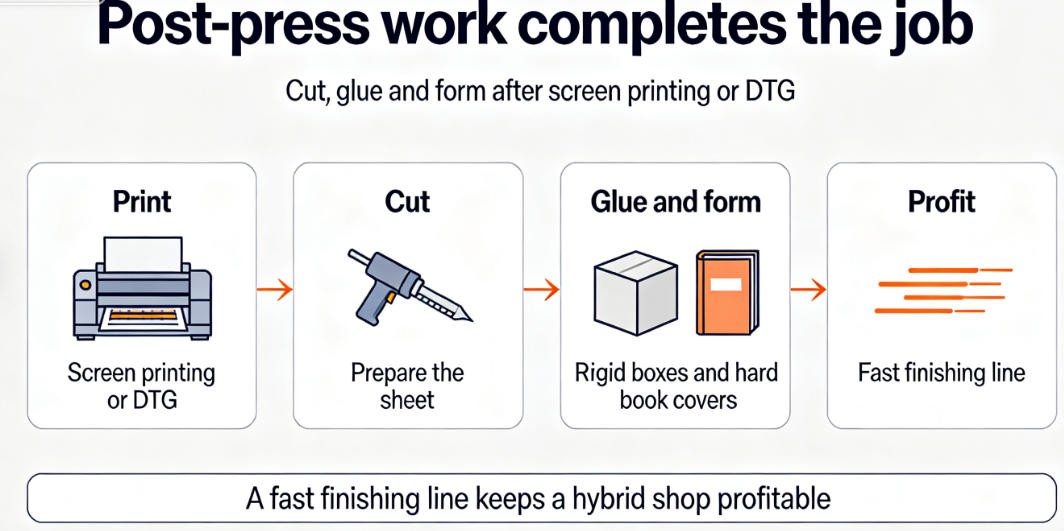
After screen printing or DTG, the piece must be cut, glued, and formed. For rigid boxes and hard book covers, that is post-press work. A fast finishing line keeps a hybrid shop profitable.
Print is not the finish
A shop can print a perfect cover. But the customer does not buy a print. The customer buys a finished box or a bound book. So the post-press step decides the final quality.
The finishing line must match the print speed
A fast digital printer needs a fast finishing line. If the box maker is slow, prints pile up. If the cover maker is slow, orders ship late. So the whole line must be balanced.
| Finishing step | Kylin machine |
|---|---|
| Make the rigid box | Semi-auto box wrapping machine |
| Make the hard cover | Book cover making machine |
| Bind the book flat | Lay flat binder |
| Make the round box | Cylindrical round box machine |
| Make the collapsible box | Box side wing machine |
I have built these machines for more than twenty years. A hybrid shop only wins if the finishing keeps up with the printing. Tell me your job and I will send you the right machine list. Request a quote.
Conclusion
Kornit's click plan makes hybrid printing simple and safe. After the print, fast post-press finishing from Kylin turns the job into a finished box or book.

发表回复