

What are the different types of corrugated boxes?
I often see buyers mix up corrugated boxes, rigid boxes, and folding cartons, and that mistake can waste money, slow packing, and hurt product safety.
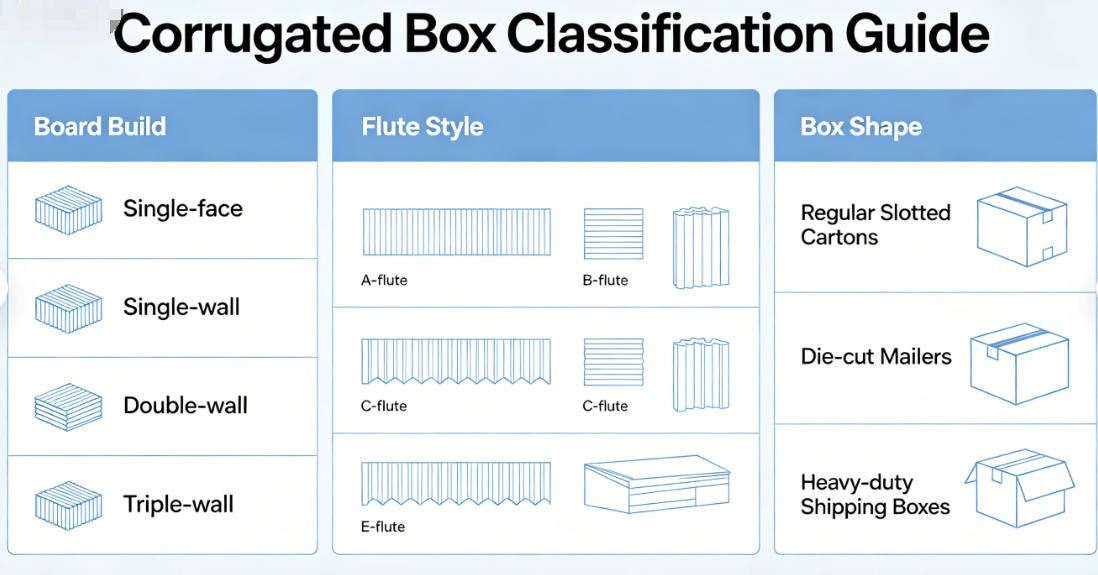
I sort corrugated boxes by board build, flute style, and box shape. In simple terms, the main choices are single-face, single-wall, double-wall, and triple-wall boards, then common box styles like regular slotted cartons, die-cut mailers, and heavy-duty shipping boxes.
When I speak with packaging buyers, I notice that most of them do not really need more jargon. They need a clear way to choose the right box for the right job. I wrote this guide in that same spirit. I want to make the subject easy, practical, and useful. I also want to help readers who may start with corrugated shipping boxes but later move into premium packaging, gift boxes, or luxury presentation boxes. When that happens, I usually suggest that they also review a few machine options on my site, such as Automatic Robotic spotter machine for rigid box making and case making, Semi auto rigid box machine, Cylindrical paper round boxes machine, and Collapsible boxes machine. If you want me to suggest the right machine, I ask you to leave your name, company, email, WhatsApp, box size, and output target through my website.
How many types of corrugated boxes are there?
I often meet buyers who think corrugated boxes are all the same, and that simple idea can lead to weak packs, extra cost, and damaged goods.
I usually say there are many box styles, but a few common ones do most of the work: regular slotted cartons, half-slotted cartons, full overlap cartons, die-cut mailers, telescope boxes, folder boxes, and partition boxes.
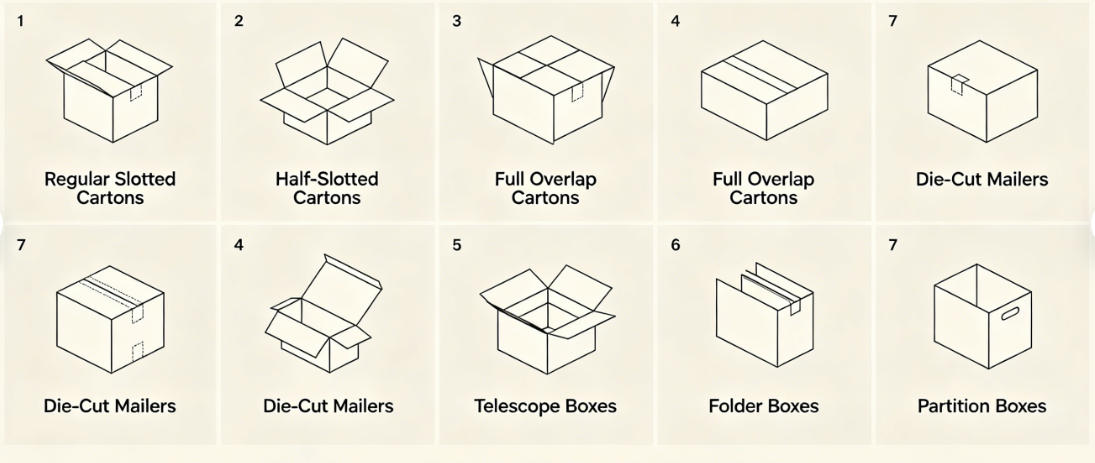
The box styles I see most
| Box type | What I use it for | Why I choose it |
|---|---|---|
| Regular slotted carton | General shipping | Low cost and easy supply |
| Half-slotted carton | Open-top packing | Fast loading |
| Full overlap carton | Heavy products | Better edge strength |
| Die-cut mailer | E-commerce and retail packs | Cleaner look and easy opening |
| Telescope box | Two-piece packs | Good top and bottom protection |
| Folder box | Flat or shallow items | Quick wrap around product |
| Partition box | Bottles or fragile parts | Keeps items apart |
When I answer this question for customers, I do not give just one number and stop. I explain that the count changes by industry and by how detailed the buyer wants to be. Some people count by structure only. Some count by flute. Some count by strength grade. In daily work, I usually start with the seven styles in the table because they are practical and easy to compare. I also remind buyers that the same style can come in different wall builds and flute types, so one style can still behave very differently in transport. A regular slotted carton made in single wall board is not the same as one made in double wall board. That is why I always ask what the product is, how far it ships, how it stacks, and how it opens on the packing line. I find that good packaging starts with those simple questions, not with a long code list.
What are the 7 types of packaging?
I see many readers search this question because they want one clean list, but the wrong list can confuse teams and slow buying decisions.
I usually explain seven practical packaging types as primary, secondary, tertiary, protective, retail display, transit, and industrial bulk packaging. The exact list can change, but these seven cover most real factory and shipping needs.
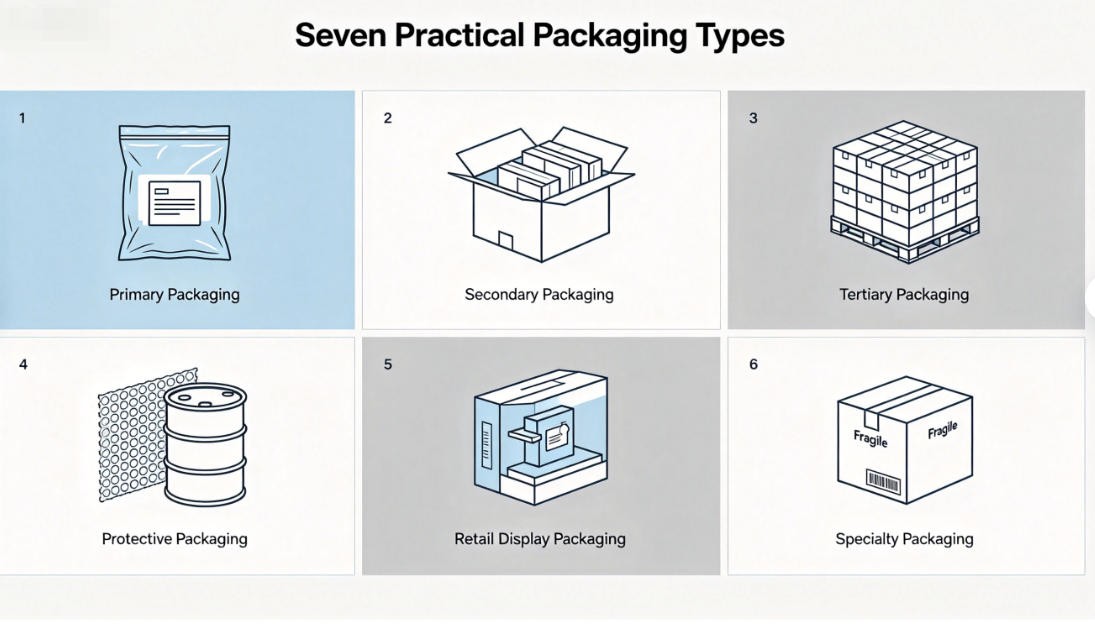
The practical groups I use
| Packaging type | Main job | Example I give |
|---|---|---|
| Primary | Touches the product | Pouch, bottle, wrapper |
| Secondary | Groups primary packs | Printed carton |
| Tertiary | Moves goods in bulk | Corrugated master carton |
| Protective | Prevents damage | Inserts, foam, pads |
| Retail display | Sells on shelf | Display-ready box |
| Transit | Handles shipping stress | Shipping case or mailer |
| Industrial bulk | Moves large volume | Heavy pallet pack or drum |
When I explain packaging types, I like to keep the answer close to factory life. Primary packaging is what the buyer or user touches first. Secondary packaging groups those units. Tertiary packaging helps move many units at once. Then I add the other four groups because I see them every day in real projects. Protective packaging matters when shock, vibration, and scratches are a risk. Retail display packaging matters when shelf appeal drives sales. Transit packaging matters when e-commerce, export, or long-distance logistics are involved. Industrial bulk packaging matters when factories move large loads between plants or to ports. I also tell customers that corrugated boxes appear in more than one group. A corrugated carton can be secondary packaging in one business and tertiary packaging in another. That is why context matters. When a customer later moves from simple shipping cartons to premium gift or rigid boxes, I usually point them to my machine range so they can compare production paths early.
What are the different types of corrugation?
I often see buyers choose a box shape first and forget the flute, and that can lead to poor print, weak stacking, or too much board cost.
I explain corrugation by flute profile and board build. The most common flute types are A, B, C, E, and F, and the common board builds are single-face, single-wall, double-wall, and triple-wall.
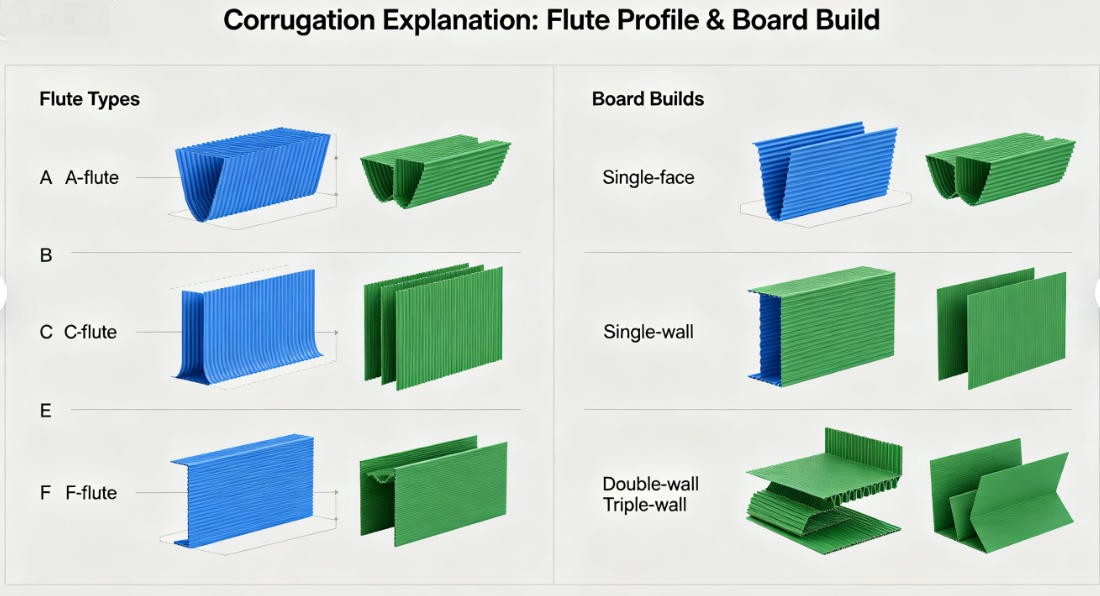
The flute types I explain first
| Flute type | What I notice | Common use |
|---|---|---|
| A flute | Thicker and more cushioning | Fragile items |
| B flute | Better crush resistance | Canned goods, inner packs |
| C flute | Balanced choice | Standard shipping cartons |
| E flute | Thin and better print face | Retail and mailers |
| F flute | Very thin and neat finish | Small retail packs |
The board builds I compare
| Board build | Structure | Where I use it |
|---|---|---|
| Single-face | One liner and one medium | Wrap and padding |
| Single-wall | Two liners, one medium | Most shipping cartons |
| Double-wall | Three liners, two mediums | Heavier products |
| Triple-wall | Four liners, three mediums | Very heavy-duty transport |
This part matters a lot because corrugation is not just a technical detail. It changes how the box performs. When I need cushioning, I think about a larger flute. When I need cleaner printing and a smaller pack size, I think about E or F flute. When I need stacking strength for export loads, I move toward double-wall or triple-wall board. I also remind customers that flute choice affects converting. A board that prints well may not give the same crush strength. A board that protects well may add bulk and shipping cost. So I do not treat flute selection as a small step. I treat it as part of the whole packaging plan. I ask about product weight, drop risk, shelf look, and warehouse stacking. Those four points usually tell me more than a long specification sheet. In my experience, the best box is the one that balances protection, print, speed, and cost at the same time.
How many types of boxes are there?
I hear this question from buyers who want one simple answer, but the truth is wider, and a narrow answer can hide better options.
I usually say there are many types of boxes, but most business use falls into a few groups: corrugated boxes, folding cartons, rigid boxes, round boxes, collapsible boxes, mailer boxes, setup boxes, and display boxes.
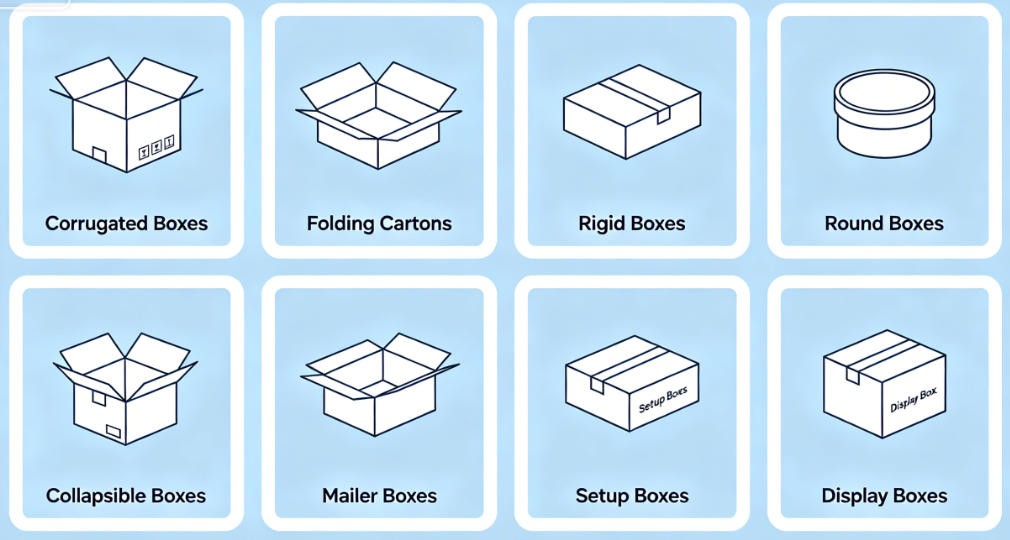
The broad box families I use
| Box family | What I mean | Where I see it |
|---|---|---|
| Corrugated boxes | Shipping and transit boxes | Logistics and e-commerce |
| Folding cartons | Printed paperboard packs | Food, cosmetics, pharma |
| Rigid boxes | Strong premium setup boxes | Gifts, phones, jewelry |
| Round boxes | Cylindrical paper boxes | Tea, candles, gift sets |
| Collapsible boxes | Fold-flat premium boxes | Luxury packaging |
| Mailer boxes | Self-locking shipper packs | Subscription and online retail |
| Display boxes | Shelf-ready packs | Retail promotion |
| Case-made boxes | Wrapped board structures | Premium presentation |
When I answer this question, I usually move beyond corrugated boxes because buyers often discover that they actually need another box family. A shipper may need corrugated outside and a rigid presentation box inside. A brand may begin with a plain mailer and later add a round box or collapsible box for a better unboxing feel. This is where my own work becomes more useful. I help customers not only understand the box names, but also think about how those boxes are made. If a customer tells me they want premium structure, neat corners, and repeatable output, I may suggest Automatic Robotic spotter machine for rigid box making and case making. If they want a compact start, I may suggest Semi auto rigid box machine. If they want round packs, I point them to Cylindrical paper round boxes machine. If they want fold-flat premium packs, I suggest Collapsible boxes machine. If you want my advice, I invite you to leave your contact details and box requirements on Kylin Machine, and I will point you to the right path.
Conclusion
I believe the best box choice comes from matching structure, flute, use, and budget, then choosing the right machine when your packaging line is ready to grow.

发表回复